I was watching Whoopi Goldberg the other night in Jumpin’ Jack Flash, laughing to myself at all those crazy 80s clothes we thought were so cool at the time, and it got me thinking about fashion in the garden. Few people would consider gardening fashion-conscious, but it really is: at various periods during the last hundred years, wildly variegated plants, boldly colored exotic annuals, even the rarest tropical orchids became the objects of collectors’ unrestrained passion—only later to fall completely out of favor as times and tastes shifted.
Of all these horticultural crazes, the one that held the widest appeal, lasted the longest, and had perhaps the greatest influence on the decorative arts as a whole, was the almost unbelievable passion for ferns that dominated British and American gardening circles up until the First World War.
The Origins of Fern Mania
The mania for ferns all started innocently enough. Before 1840, ferns had been considered pleasant additions to woodlands and wild settings, with little or no economic value beyond occasional limited medicinal use. Then in 1842 there appeared a little book by Nathaniel Ward, On the Growth of Plants in Closely Glazed Cases, which for the first time showed how plants could be grown indoors where most had previously perished.
Ward’s invention—the terrarium, or “Wardian case” as it soon became known—proved the ideal environment for cultivating delicate species never before seen in the parlor. Chief among these were the newly discovered ferns, which until then had been almost impossible to grow indoors. Their lacy fronds and intricate textures perfectly suited Victorian tastes for the rare and exotic, and soon, books on ferns and fern culture abounded (over 400 were published in Britain alone before 1900).
Within a few years, miniature glassed woodlands filled with ferns graced drawing rooms across Europe and America, and outdoor ferneries—specialty fern gardens—became a hallmark of refined estates.
Fern Hunting and the Victorian Obsession
But where to get one’s ferns? Few nurseries carried them, and fewer still understood their primitive reproductive cycle. (One of the oldest plant groups on Earth, the Pteridophyta reproduce via a two-stage cycle involving spores rather than seeds.)
The answer was simple: collect them in the wild. Fern hunting soon became a fashionable social excursion, particularly among ladies of leisure. Organized “fern forays” included picnic lunches, music, and plenty of competition. Collected ferns were used not only for transplanting but also for decoration—pressed into art, woven into wreaths, or preserved as table centerpieces.
Fern motifs began appearing on everything from linens and wallpaper to ceramics and cast ironwork—true symbols of the era’s botanical romanticism.
The Decline and Revival of Fern Gardening
By the late 1800s, the passion for ferns had grown so intense that some species became locally extinct in Britain and America. (Today, wild collecting is illegal in many places—and with the abundance of nursery-grown plants available, entirely unnecessary.) Fortunately, this fervor also inspired the creation of fern societies dedicated to cultivation and conservation, ensuring ferns’ survival in horticulture.
Yet as swiftly as the craze began, it ended. After 1914, ferns slowly slipped into the shaded corners of gardens and memory—until only recently, when their quiet beauty began to capture fresh attention once again.
Ferns for Modern Gardens
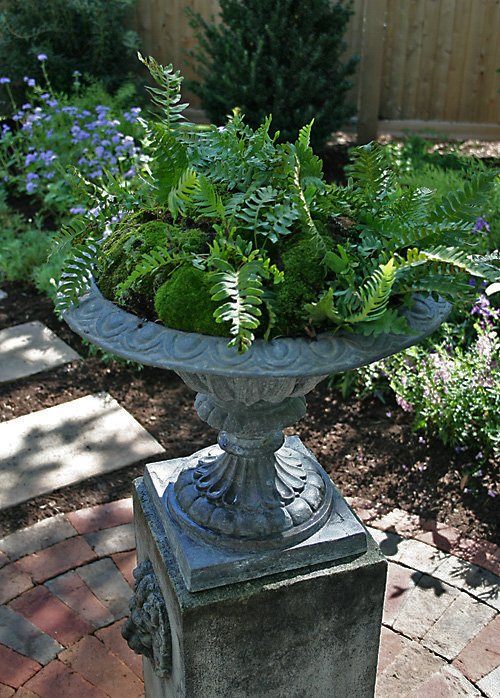
Despite being perfectly suited to shaded, hard-to-fill areas, ferns remain underused in American gardens—perhaps due to the mistaken belief that they are fragile or demand constant moisture. In reality, many are hardy, adaptable, and surprisingly tolerant of a range of sites.
The greatest difficulty may simply be choosing from the abundance available. Generally, species from the Dryopteris (wood ferns) and Polystichum (shield ferns) families offer some of the toughest and most dependable choices.
Recommended Garden Ferns
Dryopteris (Wood Ferns)
- Dryopteris carthusiana — Spinulose wood fern, zone 3. Graceful, lacy fronds forming upright clumps; cold- and moisture-tolerant.
- Dryopteris erythrosora — Autumn fern, zone 6. New fronds emerge copper-red before maturing to deep green, adding seasonal interest.
- Dryopteris filix-mas — Male fern, zone 4. A classic and rugged species thriving in many soil types.
- Dryopteris formosa — Formosan wood fern, zone 7. Elegant arching fronds; excellent for warmer shaded regions.
- Dryopteris intermedia — Fancy wood fern, zone 4. Finely divided, semi-evergreen, perfect for cool woodland sites.
- Dryopteris marginalis — Marginal wood fern, zone 4. Blue-green fronds with unique spore clusters along the margins.
- Dryopteris × remota — Hybrid wood fern, zone 5. Vigorous hybrid noted for lush form and adaptability.
Polystichum (Shield or Holly Ferns)
- Polystichum acrostichoides — Christmas fern, zone 3. Evergreen, sturdy, perfect for erosion control and winter interest.
- Polystichum braunii — Braun’s holly fern, zone 4. Glossy green fronds with a neat, semi-evergreen habit.
- Polystichum munitum — Western sword fern, zone 6. A Pacific Northwest native; bold and architectural.
- Polystichum setiferum (cultivars) — Soft shield fern, zone 5. Feathery and refined, available in many graceful forms.
Other Excellent Ferns
- Athyrium filix-femina — Lady fern, zone 3. Tall, light-textured fronds; classic woodland choice.
- Athyrium niponicum ‘Pictum’ — Japanese painted fern, zone 4. Iridescent silver and purple-gray foliage; thrives in bright shade.
- Matteuccia struthiopteris — Ostrich fern, zone 3. Tall, vase-shaped; produces edible spring fiddleheads.
- Osmunda cinnamomea — Cinnamon fern, zone 3. Bold fronds with warm cinnamon-colored fertile spikes.
- Osmunda regalis — Royal fern, zone 3. Majestic, open-fronded species ideal for damp sites.
- Adiantum pedatum — Northern maidenhair fern, zone 4. Airy, fan-shaped foliage on inky black stems; superb for shaded borders.
Fern Culture at a Glance
Though vast and diverse, most ferns share a few cultural preferences:
- Soil: Rich, moisture-retentive, and well-draining (woodland leaf mold is ideal).
- Light: Partial to full shade; avoid harsh midday sun.
- Wind: Minimal exposure—fronds are delicate and can tear easily.
- pH: Generally tolerant of a wide range, though neutral to slightly acidic is best.
Drying and Using Ferns
Pressed fern fronds make exquisite art and craft materials, lending delicate botanical detail to cards, vases, or framed pieces.
To press, place fronds between absorbent layers of newspaper, blotting paper, or tissue. Specialized plant presses using botanical blotters and corrugated cardboard (available from Forestry Suppliers) make the process even easier. Use a small piece of masking tape to position each fern. Apply steady weight for several days, then remove the tape and allow a full week for drying. Once pressed, mount on quality art paper or board for timeless natural artwork.