In many ways, I owe my horticultural career to tall bearded iris. This may sound strange, but it’s true. These iris were my grandfather’s passion: he adored the plant, and as I adored my grandfather, it soon became clear that if I wanted to spend any kind of quality time with the man, I had better love them too. And thus it happened that I learned all about iris, and by extension, gardening in general. By eight years old I had advanced sufficiently in my grandfather’s rather stern estimation to merit my own row behind the garage in Grandpa’s “trial garden,” where he tested his new crosses. This was quite an honor (Grandpa didn’t let just anybody fool around with his beloved iris), and the depth of my childhood pride is mirrored by the fact that after more than a quarter century, I can still recall the evocative names my first iris bore, in the order they appeared in their row: Pacific Palisades, Latin Lover, Winter Olympics, Stepping Out… and on down the line. By nine years old I had bred my first hybrids (nothing spectacular, I’m sorry to say), and by ten I was the youngest member of the National Iris Society. Advancement came quickly in the iris ranks.
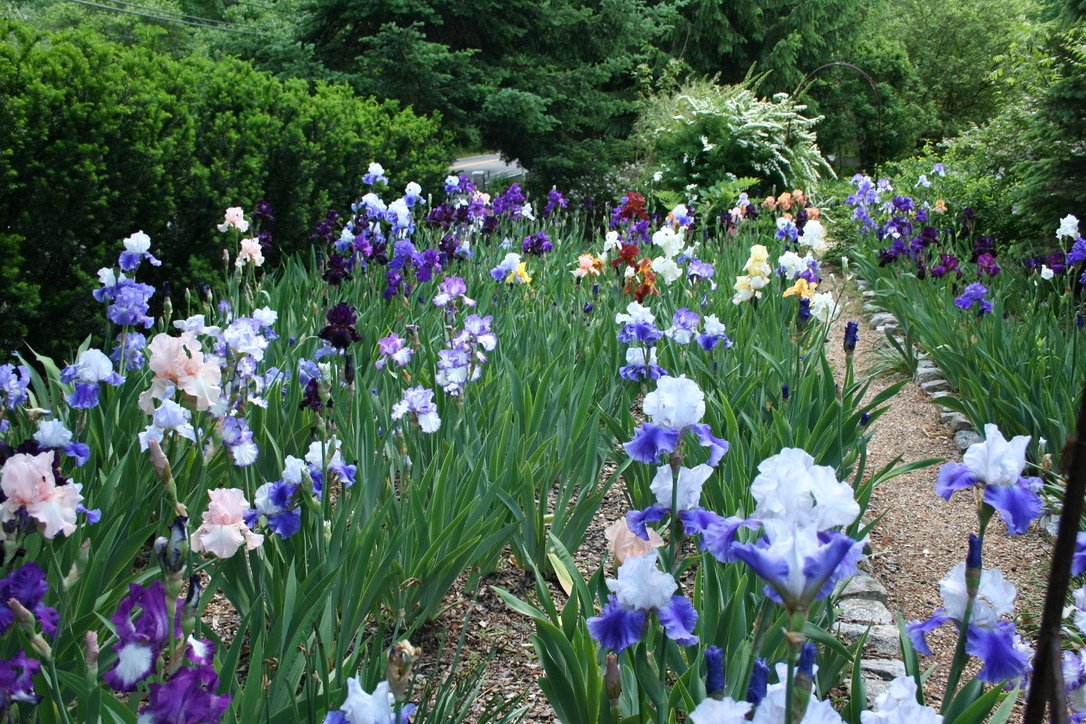
Now, you may be wondering how two people—one in his seventies, the other still not twelve—could become so involved with a single plant. If you are, I know for sure that you haven’t grown these beauties in your garden. If you had, you would immediately recognize their almost irresistible allure. In fact, most people have never seen flowers quite like these. Bloom time occurs in late May and early June, when iris send up two- to three-foot stalks from a fan of typically sword-shaped, glaucous leaves, each bearing three to seven blooms. The flowers, which are three to five inches across, come in colors ranging from the purest white to the deepest, darkest purple (and everything in between). The buds open from top to bottom along the stem, revealing flowers with three upper petals (called standards) and three lower ones (falls), with the eponymous beards in the center of each. The texture of the flowers is the most incredible, opalescent velveteen, which absolutely invites caress.
One story should suffice to convince you of this flower’s power to please: most of my iris are in a special garden located quite near the road and surrounded by a low stone wall. When the iris bloom, traffic on the road—normally whizzing past at forty miles an hour—suddenly crawls to a standstill, with eager drivers gaping at the magnificent blooms. Last year, the display was such a show-stopper that one man came down the drive, asking to purchase twenty stalks of flowers for his wife at ten dollars apiece! I’m afraid I refused to sell him any (I couldn’t bear to part with that many to a complete stranger), but I did send him on his way with several as a gift, and instructions on where he could find plants for his own yard. (See sources.)
Iris, in fact, make spectacular cut flowers—ones you’ll never see in a florist shop due to the impossibility of shipping such fragile blossoms. At home, however, cut for the vase, they are stupendous. Many, indeed most, varieties are also quite fragrant, and each and every blossom on the stem will open over the course of a week or more. (There was also the time I traded an armload of iris with the concierge at the Plaza in New York for an upgrade to a fifth-floor suite overlooking the park, but that tale will have to wait for another day…) My grandfather, who grew thousands of plants, was legendary for both his bouquets and his generosity in giving them away (unlike, it seems, his grandson, who hoards every bloom—though in all fairness, I grow far fewer). Every year he would visit all his friends and family, bearing the most magnificent bouquets imaginable—twenty or thirty huge stems to each. Interestingly enough, my mother, who is the only person I know who never seemed to care much for iris, used to dread this time of year. My grandfather would perennially arrive bearing a veritable carload of blossoms, which my mother would dutifully place in huge vases about the house, muttering to herself the entire time, “All these flowers to arrange, and he knows all I ever wanted were the lilacs!” (Grandpa, who was equally rich in lilacs, blithely ignored my mother because, unlike iris, cutting lilacs reduces next year’s bloom.) I, of course, was in heaven, and one of my fondest memories as a little boy was waking up on those wonderful June mornings surrounded by the rich perfume of iris permeating the house.
If all this seems too good to be true, you’re right—it is. There’s a darker side to iris, called the iris borer. In certain areas of the country—namely, a line running east of the Mississippi and north of Washington, D.C., where of course I have always had the bad luck to live—this nefarious pest, the offspring of the most unremarkable tan-colored moth, will literally mine the leaves, chewing its way down the fan and into the center of the rhizome, leaving a gooey, fatal trail of destruction in its wake. Left unchecked, the infestation will spread and destroy the entire planting. While surgery is possible to remove the grub, the process is disgusting and often useless. Assiduous collection of the dead leaves where the moths lay their eggs, and thorough disposal in early spring before growth starts, will often reduce the problem substantially, but in all honesty, the only recourse we have ever found is spraying just as leaf growth begins with a systemic insecticide. Iris are, in fact, the only plant I ever routinely spray. Those of you outside the green line won’t have to worry about this problem, and now I’m told that an application of a special nematode early in spring may be an effective organic substitute. I intend to try this next season and keep my fingers crossed. Interestingly enough, the grandparents of most of today’s modern cultivars seem blissfully immune to the borer—as if, in their attempt to produce more and varied colors, more thoroughly ruffled falls, and to my mind at least, other unnecessarily cinemascopic effects, breeders have somehow attenuated the plant’s natural defenses. All in all, it seems to me a cautionary tale in plant hybridization, and one not sufficiently respected by today’s plant producers.
Other than the great borer bane, iris are remarkably easy to grow: they are indifferent to soil pH (though they prefer a bit of lime if offered), require only modest fertility, are drought resistant, and are hardy over most of the U.S. except southern Florida and the Gulf Coast. Iris make good companions in the general border, though their leaves sometimes tend to get rather ratty by late summer, and if planted in large numbers can drag down the general appearance of the planting. I prefer to grow my iris apart, in an iris cutting garden of sorts, where I can tend them as they require, and then not worry about them when they aren’t at their best. The time to plant iris is July and August, right after bloom—wonderful varieties can be mail-ordered from a large number of suppliers. Iris are also quite long-lived; maintained and tended, a clump will continue indefinitely. In fact, I have several plants in my own garden which once grew at my grandfather’s more than thirty years ago—a living legacy from a remarkable man, thanks to a truly remarkable plant.
Sources:
While there are many sources for mail-order iris, my hands-down favorite (and my grandfather’s, who had been ordering from them since the 1920s) is Schreiner’s, 3625 Quinaby Road NE, Salem, Oregon 97303. 800.525.2367. http://www.schreinersgardens.com