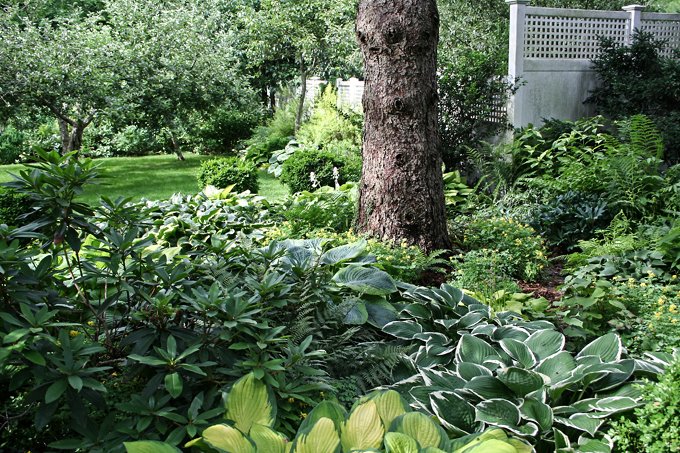
 Mention the word shade, and the gardener’s brow will often start to furrow, calculating ways to escape this dark menace. That’s really a shame, for while gardening in the shade does often present a number of challenges—poor soil, competition from tree roots, and a much more muted color palette than sunny borders, for example—shade gardening also possesses its own distinct charms: plants with wonderful foliage variegations, subtle and interesting flowers, and fascinatingly delicate forms. The fact of the matter is, though, whether you enjoy shade gardening or not, at one point or another in our gardening careers most of us are going to have to deal with shady garden areas. (Many of these increasingly shaded areas are the product of our own ambitious planting in years past!) The success of your gardening efforts there will be determined to a great extent by how well you understand the various distinct natures of shade.
Not all shade is created equal, and more than in other types of gardening, successful shade gardening requires excellent powers of observation to discern your exact growing conditions. Your very first consideration when laying out a shade garden should be to decide how much—or how little—direct sunlight reaches your garden area. For some reason, many gardeners find this rather straightforward task extremely difficult and are tempted to “cheat up” the amount of light that is truly available to their garden, as if somehow the lack of sun reflects badly on them. If asked, these gardeners will typically reply that such-and-such an area receives “a half day’s light,” when in reality only one or two hours of feeble light ever reach the spot. This kind of fudging will only lead to failure, as most plants are far more precise than their gardeners about how much light they require. If your garden receives no direct sunlight (like that cast on the north side of a tall building) or only one or two hours a day of direct sunlight at the beginning or end of the day, this is considered deep shade. Only plants that truly like full shade will tolerate these conditions (those marked with the fully darkened sun symbol on the label), and despite the siren call of other, more light-loving varieties, you must limit your nursery selections accordingly.
Three to four hours of direct sunlight—or dappled light throughout the day (such as the conditions found under a large tree)—are considered partial shade. This situation is ideal for shade gardening and allows for a much wider range of plant material. Remember, when choosing your plants, that while full-shade lovers will often tolerate the brighter conditions of partial shade, the reverse is rarely true: partial-shade lovers will generally sulk and slowly deteriorate in full shade. So unless you plan to continually replant your garden—and have a budget to match—being honest about your light conditions is a must. (As an important aside to this discussion, remember that light conditions often change over the course of a year. In early spring, for instance, before the trees leaf out, an area that is in deep shade later in the summer is often in partial to full sun early in the season. Light-loving plants that complete their full life cycle during this brief sunny period, such as many of the early spring bulbs, can be safely planted here, to be followed by other more shade-loving plants later in the season.)
Another extremely important consideration when planning a shade garden is how much water the area in question receives. Many gardeners somehow presume that because an area is shady, it’s also moist—which can be a fatal mistake. In fact, most shady areas, especially those under trees, are quite dry, due to two factors. First, the canopy of a tree acts like a giant umbrella, diverting water from falling on the ground underneath. Second, what little water does manage to fall through the leaves is immediately sucked up by greedy masses of tree roots. While there are plants that will thrive in either dry or wet shade, it’s critical to ascertain which you have and choose plant material accordingly. (A good guide, such as Taylor’s Guide to Shade Gardening [Houghton Mifflin, 1994], is a must.) Fortunately for dry-shade areas, additional irrigation—either in the form of a permanent watering system or a willing gardener with a strong back to lug hoses—will often be enough to mitigate the situation, provided that you ignore a generally accepted maxim about watering: dry-shade areas often require watering even when the rest of the garden has received an adequate amount of natural rainfall, once again due to the umbrella effect. One to two inches of water a week are required for most gardens. Stationing a watering gauge in your dry-shade areas will remove any doubt about when to water.
The final, and perhaps most important, element of success in any shade garden is the condition of your soil. As in any other gardening endeavor, improving the soil is key to making plants thrive, but in shade gardening, good soil is especially critical. Given the low-light conditions of shade gardens and the shade plants’ reduced ability to generate energy from sunlight, a healthy soil full of nutrients and organic matter is a must. This is often particularly difficult to achieve when gardening under trees, where large, insidious roots thread through the ground, soaking up every possible nutrient. These same roots also render normal soil preparation, especially with any kind of mechanical device, almost impossible. While an occasional root may be snipped to create a deep planting pocket without doing much harm to the tree, root pruning on any larger scale will prove extremely deleterious—both to you, in terms of your back, and to the tree, in terms of future growth. In the case of extremely rooty soil, it’s best to build upwards: as long as you begin a few feet away from the tree trunk, you can safely add three to six inches of compost or (preferably) leaf mould (see the sidebar) and plant in that instead. Over time, the tree roots will eventually discover this earthen feast above them and begin to spread through it. By that time, however, your shade garden will be successfully established—and you and your plants won’t mind sharing the bounty of your labors.