
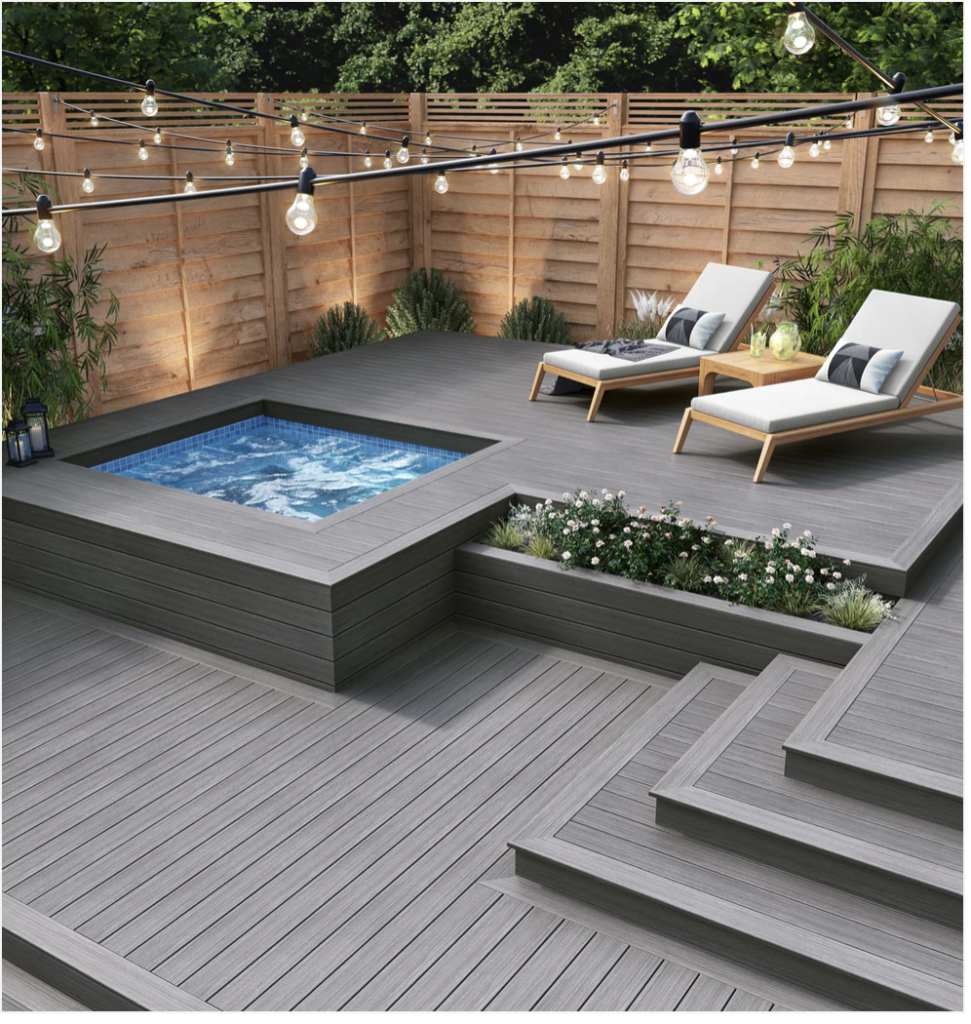
I suppose I should begin by admitting that I’m generally not a big fan of decks in the landscape. In fact, the only kind of decks I’m really fond of are the ones attached to large, luxurious ocean liners. It’s not that decks are intrinsically bad in the garden; it’s just that most of the huge, overblown structures you often see today can only be described as downright ugly. Curiously, decks didn’t start out this way: when they first appeared in the 1960s, decks were fairly modest, unobtrusive affairs—built low to the ground and hugging the house, they were really just simplified versions of the wonderful Victorian porches that had preceded them.
Then suddenly, during the 1980s, decks started to appear hanging off the sides of homes five, ten, fifteen feet above the level of the land below, like some giant stilt-legged spider trying to envelop the back of the house. A drive through any modern subdivision will show you example after example of these pressure-treated monstrosities. Not only are these structures aesthetically impoverished, they are impossible to integrate successfully into the overall landscape. To begin with, the dry, shaded, barren earth below them is absolutely useless, except for unsightly storage. What’s more, usage of the structure itself is compromised—with the deck hanging off the back of your house fifteen feet or more above the ground, you are subject to every burning ray of sun, cold gust of wind, and prying stare from your neighbors that may come your way. Decks like these don’t function as either part of the garden or part of the house, and should be avoided at all costs (which conversely should save you a lot of money, because they are also extremely expensive!).
So what’s today’s homeowner to do? Well, if you have one of these spider-like things already, you are stuck until time and circumstances allow its removal. In new construction, or where the opportunity for remodeling exists, keeping in mind some simple rules will help create an outdoor living area that is an asset to your garden rather than a liability. The first step is to consider whether you really need a deck at all, or whether some sort of terrace would be a better option. Terraces have a number of benefits over decks: they generally don’t require licensed plans and a building permit as decks do; they are often easier to design and generally yield a more aesthetically pleasing result, especially if you take some care to match the surfacing material to those already used in the house and around the yard. Terraces also allow better flow of traffic between indoors and out, as there are generally more means of entering and exiting an open terrace than there would be from a railed deck. This ease of movement is an important consideration, because a terrace can provide a space with a much more expansive feel than the enclosed, constrictive sensation that any railed, raised structure could afford. Finally, given the rising price of lumber these days, terraces are often less expensive (and more environmentally friendly) to construct than decks—especially where rare and expensive woods such as endangered redwood or teak are used.
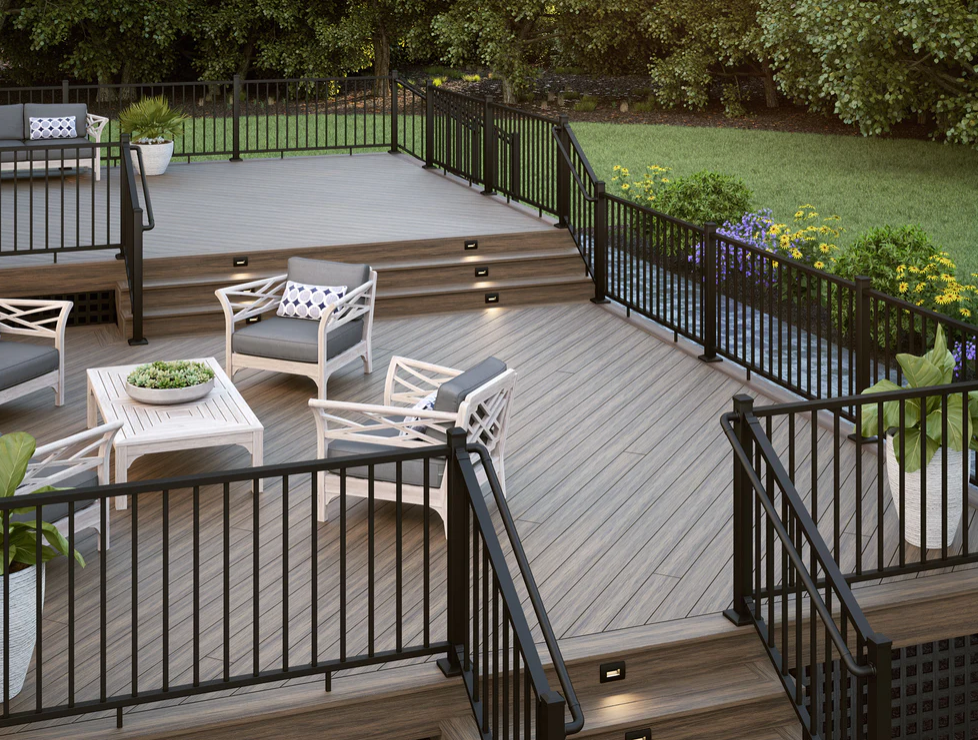
There are, however, some situations where decks are appropriate. There are times, for instance, when a deck is actually the best stylistic match for the existing architecture of a home and landscape. Next to a modern, wooden house, for example, or a rustic chalet-style home, a nicely detailed deck might be the best option for an outdoor living area. Decks are also a good choice when the topography of the yard is such that a level surface is not easily achievable by other means, such as on top of a rocky outcrop. A third reason to use decks in the landscape is when a transition from one level to another is required that would be impossible with a terrace or patio. But keep in mind that even in these circumstances, decks should be kept as low to the ground as possible—the final level should be no more than two or three feet above the existing grade. Don’t try to use decks as a means to make a transition of a story or more from the back of the house to the yard level—it just won’t work. In new houses, design the floor plan so that you have direct access from the kitchen or back levels more or less at ground level. In existing homes, where the layout may be impossible to alter, you may simply have to call a spade a spade and construct a well-built porch or balcony instead, consistent with the architecture of the house.
If you decide that a deck is right for you, your next task—after finding a good contractor (building a deck is not a project for the uninitiated, and in fact most states require a licensed builder)—will be to choose the decking material. Your contractor should be able to offer you a wide variety of options, each with its pluses and minuses. The most commonly used material for deck construction is pressure-treated wood, which is generally made from chemically treated pine. While extremely versatile and easy to use, pressure-treated wood has the disadvantage that it can’t generally be painted or stained for months after installation, and it can often splinter—an important consideration if babies or small children will be crawling around the surface. There is also the often-overlooked issue of disposal: the leftover bits and pieces can’t be burned (the smoke is toxic), and many landfills and transfer stations now refuse to accept it as environmentally hazardous waste. If you do choose pressure-treated wood, make sure the contractor settles the disposal issues beforehand and uses the highest grade of pressure-treated wood, which should be guaranteed against rot for at least 30 years.
Cedar is also a possibility, as it is naturally resistant to rot, but it is a rather soft wood and not ideal for decking. Fir is another option; harder and less prone to splintering, it also develops a lovely sheen with age. The downside with fir is that it must be rigorously maintained with preservatives every year or so. Redwood and teak are the most expensive choices. Both are extremely durable woods that are naturally resistant to rot. Personally, though, I cannot bring myself to use either: the slow-growing redwood seems far too majestic to be chopped into decking planks, and the environmental damage caused by ripping teak trees from tropical rainforests is almost mind-boggling, even from supposedly conservation-minded “plantations.” Instead of cutting down the rainforests, why not consider a much more environmentally sensible option—plastic lumber. Now widely available, this introduction, made partially from recycled plastics, is completely impervious to rot and comes in a variety of colors, including realistic faux-grained wood tones. I have used it now for the better part of a decade, slowly replacing failing wood surfaces, and frankly would be hard pressed to recommend anything else. The downside is the upfront cost: it is considerably more expensive than real wood, but when you factor in total lifetime costs, its really a no-brainer.
Finally, when designing your deck, make sure that the style and detailing of the deck match those of the house. Building a deck is a remarkably expensive enterprise, and there can sometimes be a tendency to cut corners and skimp on what may seem at first glance to be non-essentials. This is a big mistake, as it’s the finishing details that often determine how successful a structure is. I’ve known people to spend thirty thousand dollars constructing a huge, elaborate deck, and then decide to forgo the thousand extra dollars required to install well-crafted spindles, railings, built-in planters, and other elements that make the structure actually look like something and unite it to the house and landscape. Like everything else in the garden, if money is an issue, wait until you are comfortable with the expenditure and build what you really want; don’t compromise on something less. You’ll never be satisfied with the trade-off, and it will only wind up costing more in the end. Remember, a deck is really part of your home—an extension of the house into the garden. Built correctly, it will be an addition to both; but poorly designed or poorly constructed, and all you’ll wind up with is an expensive eyesore.