“Daffodils,
That come before the swallow dares, and take
The winds of March with beauty.”
— William Shakespeare, The Winter’s Tale
Right now as you read this, the first daffodils will be pushing up through the still half-frozen soil in my garden. While they are not the earliest bulbs to appear – the miniature crocus, snowdrops, and tiny iris reticulata generally beat the daffodils by several weeks – for me, it’s the daffodils that are the true harbingers of spring. For although the smaller bulbs may be the first to bloom, they often do so while there is still snow on the ground, which always seems to me a slightly cruel jest: it’s bad enough to have to endure further extended cycles of slush, snow and freezing rain, without having these little jokers teasing you with hints of spring’s still distant beauty. In contrast, when the daffodils arrive, you can be certain that spring truly is just around the corner, and that all the verdant pleasures of the new gardening year will soon be at hand.
Interestingly for such a cheerful blossom, the daffodil’s first association with man was far more lugubrious: the ancient cultures of the Mediterranean considered the flowers sacred to the gods of the underworld. They were used by the Egyptians, for instance, in funeral wreathes, examples of which have been found perfectly preserved in tombs after 3000 years. This association with mortality perhaps also explains the flower’s botanical name, Narcissus, which according to the Roman encyclopedist Pliny does not derive, as is commonly still thought, from the myth of Narcissus, the beautiful boy who fell in love with his reflection, but rather from the Greek narke, or “narcotic,” reflecting the belief that the flower’s strong fragrance caused death-like numbness and slumber. In fact, Roman myth relates that it was while picking daffodils that Persephone was overcome by the fragrance and fell asleep, thus allowing Pluto to carry her off to the Underworld to be his bride. The derivation of the plant’s English name, “daffodil,” is even murkier, befitting a flower of such dark associations. “Affodyl” is supposedly a corruption of the name of an entirely different species, the white “asphodel,” (strangely enough another flower the Greeks associated with death) which by the early 1500s had become linked with the white varieties of the narcissus family. The yellow varieties were later incorporated as well under this moniker (including the utterly charming variation “Daffadowndyllyes”) though for another century, purists insisted on calling the yellow types Pseudo, or False Narcissus.
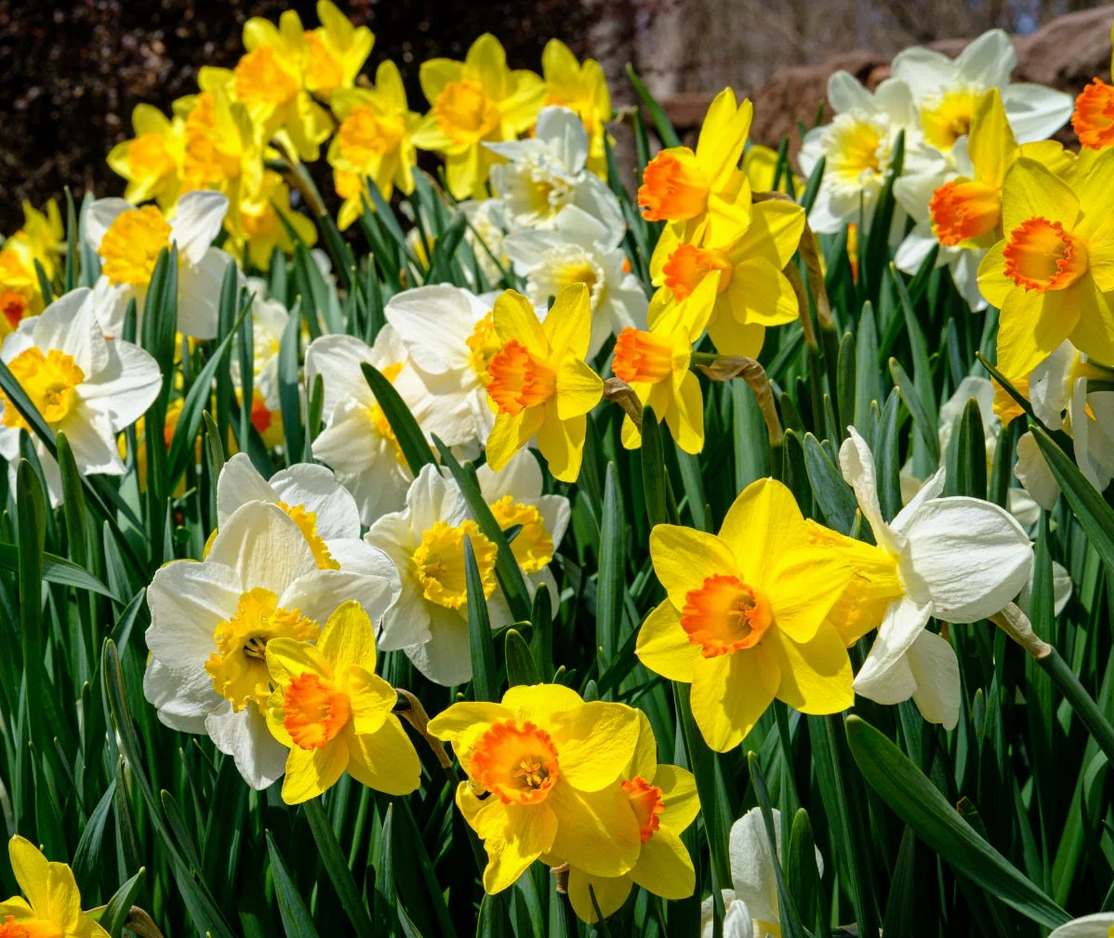
Unfortunately for the beginning gardener, things haven’t gotten any less complicated in the daffodil nomenclature department. The family is divided into no less than 13 divisions according to flower type, mostly having to do with the size of the central cup, number of petals, or number of flowers on each stem. Needless to say, this all makes choosing narcissus varieties for your garden more complicated than it really needs to be. For my purposes, I like to ignore the botanical divisions, and divide the family into three simple groups: early, middle and late bloomers, which is really the most important characteristic for anyone trying to sequence the longest possible floral display. Indeed, if you plan correctly, you can extend the daffodil’s blooming season to well over a month. Within each of these categories, of course, there are subdivisions: flowers of various colors, sizes, and scent. Which you choose is entirely up to you, your taste, and how you plan to use your bulbs. I, for instance, happen to prefer the white or mostly white varieties over the total yellows, because I think they blend best in the spring landscape, especially when under-planted with other small bulbs like blue Muscari, or set off in large naturalized clumps on the edge of field or woodland. I also like to use the smaller, scented varieties in places where I am sure to pass nearby: their delicate blossoms and incredible fragrance are best when appreciated close at hand. These considerations are of course entirely subjective; the important point is to start making big use of this wonderful bulb in your landscape if you haven’t already.
The good news is that all daffodils, regardless of type, can be treated pretty much the same way in the garden. Daffodils benefit from a fairly rich, well-drained soil, and prefer full sun. (A few hours of dappled shade is OK, as are places that are in full sun early in the season, but become partially shaded as the tree canopy fills in.) Bulbs are purchased and planted in the fall for spring bloom. One caveat when buying: Make sure you purchase top grade bulbs. Daffodils and many other bulbs are graded according to size and quality. Bigger, firmer bulbs mean better flowers; smallish, soft-ish bulbs may fail entirely, so avoid any of dubious quality, even if less expensive. Planting depth and spacing will vary according to the specific variety, but in general, all daffodils appreciate a handful of super-phosphate and a bit of 10-10-10 at the time of planting.
Buy as many bulbs as you can afford, both in terms of money and space; it’s amazing how fast a few hundred bulbs can disappear into a large landscape with hardly a notice. And don’t succumb to the common temptation of ignoring the spacing directions when you plant, clumping as many bulbs as you can fit into a single hole. Although your first year planting will be full, successive years will see a diminution in both flower quality and size. Daffodils multiply by division, producing small side bulblets each year that will rapidly overcrowd an improperly spaced planting. Also make sure, under no circumstances, to remove the foliage after flowering until it has completely browned and died back. Premature removal of the leaves will deny the bulb the energy it needs to form a flower bud for next season. If the rather ratty nature of the foliage begins to annoy you, simply tie the leaves up into a less conspicuous knot, and remove when brown. Or better yet, do what I do: plant your daffodils underneath large perennials like hosta that emerge after the daffodils bloom. The hosta, with their large umbrella-like leaves, hide the decaying foliage in a perfectly sequenced horticultural ballet, saving you all the effort of removing those daffodil remains yourself.
So this year, plan ahead: now as each new daffodil begins to sway to the joyous dance of spring, grab your pad and pencil, and start noting down varieties and planting combinations that please you. Because sooner than you think it will be fall, and time to plant these wonderful harbingers of the new season in your garden.
Early Bloom (Feb-Mar)
-
Rijnveld’s Early Sensation: Classic yellow trumpet; one of the earliest to flower, great for winter color. Height: 12-14 in.
-
February Gold: Bright yellow with reflexed petals; vigorous for rock gardens. Height: 10-12 in.
-
Tête-à-Tête: Miniature yellow; 2-3 blooms per stem, perfect for pots. Height: 6-8 in.
-
Jetfire: Lemon petals, orange cup; wind-resistant dwarf. Height: 10-12 in.
-
Ceylon: Yellow petals, red-orange cup; longest-lasting early blooms. Height: 12-14 in.
-
Marieke: Large golden trumpets; bold for mass plantings. Height: 14-16 in.
-
First Hope (January Gold): Pure yellow; blooms in mild winters. Height: 12 in.
-
Avalanche: Multi-flowering white with yellow cups; fragrant clusters. Height: 16-18 in.
-
Barrett Browning: White petals, red-orange cup; striking contrast. Height: 14-16 in.
-
Ice Follies: White with yellow trumpet fading to white; reliable perennial. Height: 16-18 in.
Mid-Season Bloom (Mar-Apr)
-
Carlton: Classic two-toned yellow; top performer, vanilla-scented. Height: 16-18 in.
-
Thalia: Pure white triandrus; 3-5 fragrant blooms per stem. Height: 14-16 in.
-
Fortune: Soft yellow large-cup; great naturalizer in shade. Height: 16-20 in.
-
Jet Fire: Yellow petals, orange trumpet; weatherproof for borders. Height: 10 in.
-
Geranium: Cream petals, orange-red cup; fragrant clusters. Height: 12-14 in.
-
Ziva: Pure white tazetta; heavily fragrant, not hardy in Boston; used for forcing. Height: 14-16 in.
-
Abba: Double white with orange flecks; spicy fragrance. Height: 14-16 in.
-
Bridal Crown: Double white; elegant mid-season filler. Height: 16 in.
Late Bloom (Apr-May)
-
Pheasant Eye (poeticus recurvus): White petals, orange eye; jasmine-scented cottage classic. Height: 16 in.
-
Actaea: White with red-rimmed cup; poeticus-type fragrance. Height: 16-18 in.
-
Sir Winston Churchill: Pink-cupped; unusual color for late show. Height: 16-18 in.
-
Salome: Pink-orange cup; long-lasting late blooms. Height: 18 in.
-
Will Scarlett: Red-cupped; rare color for extended season. Height: 16 in.
| Bloom Group | Count | Key Tips |
|---|---|---|
| Early | 10 | Plant in sun; deer-resistant starters. |
| Mid | 8 | Versatile for lawns/shade; best multipliers. |
| Late | 5 | Fragrant finales; pair with perennials. |
For continuous color, mix groups and plant in fall at 6-in. depth in well-drained soil.