
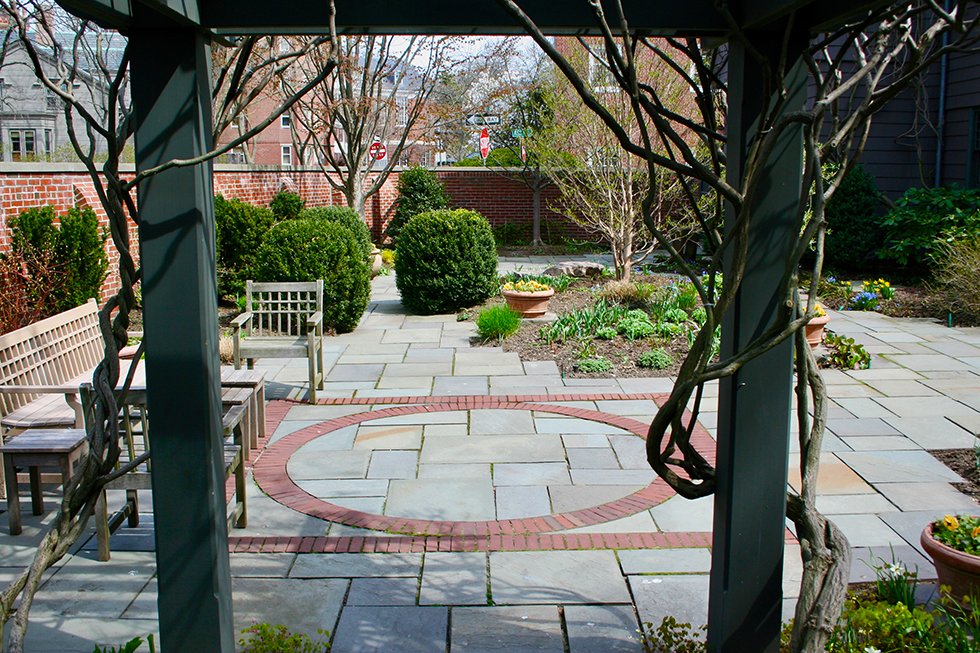
To my way of thinking, a relaxing, well-designed terrace or patio is the most important feature of the entire landscape. It’s here, after all, that you get to reap the rewards of all that hard labor—hours spent weeding, mulching, and planting come to fruition when you sit down in a comfortable chair with a cool beverage, survey your domain, and drink in the pleasures of a job well done. But for the owner of a traditional home, obtaining this dream space can be full of pitfalls, as outdoor living areas can quickly turn from adjunct to albatross if improperly designed. The key to success is to consider the two most important aspects of any terrace or patio—dimensions and materials—long before you move the first shovelful of dirt.
Size Counts
As a landscape designer, I was taught early on that outdoor living spaces “can rarely be too big,” and while I’ve found the occasional exception to this dictum, by and large it’s true. Most outdoor living areas built today are too small for their intended use, something that the average homeowner generally doesn’t discover until it’s far too late—after the project is completed.
Unfortunately, this is one arena of outdoor design where appearances can be extremely deceptive. Even when you follow standard advice, physically marking out the boundary lines of a proposed space with paint or string, the area always looks huge, and human inclination is to err on the side of discretion and plan for a smaller (not to mention less costly) terrace. Before you make final decisions on square footage, however, you should do this simple test: envision the social occasions you think will most often occur on your new patio and calculate the number of people involved (barbecues for six, for example, a cocktail party for twenty, or a romantic dinner for two). Next, place enough furniture (in a pinch, scaled cardboard cutouts will do; see the sidebar for required sizes) to allow for everyone to sit down, as well as a few large empty pots or planters in areas where they might occur in the final design. Then, borrow a few live bodies in the form of friends or family members and have them come and stand within the boundaries you’ve been contemplating. Chances are you’ll discover that considerable expansion is called for.
Match Hardscape to House
Once you’ve determined how much square footage you’ll need, your next consideration is the overall look and feel of your space, and here you should be guided by one of the basic tenets of traditionally inspired landscape design: the style of your house and that of your garden must be closely related and completely complementary. This is especially true for outdoor living areas, which function as an extension of your home’s architecture into the landscape. Thus, when contemplating various materials for your terrace or patio, it’s critical that you limit your choices to materials that are sympathetic to those already found in and around your home. For most traditional building styles, that means familiarizing yourself with the two most traditional of all paving mediums: brick and stone.
Brick
It’s a safe bet to assume that most people think that all bricks are pretty much created equal—that is, until they go to buy them and find out that bricks come in a bewildering array of shapes, colors, and costs. Essentially, all bricks can be divided into two basic types: molded and wire-cut. Wire-cut bricks are extremely uniform and, because of their regularity, are easier to lay, especially when creating complicated patterns. Molded bricks are much more randomly shaped and often vary considerably in width and length. While such bricks are more difficult to install (especially in more intricate patterns such as herringbone), to my eye their handmade look is much more appealing in traditional applications.
Both molded and wire-cut bricks come in a wide variety of colors, ranging from light creamy yellow through orange to every shade of red and even brown, and this difference will have a major impact on the final look of your project, in much the same way that changing the color of your interior flooring will drastically alter a room’s appearance. If you’re unsure which hue is best for your project, it’s a good idea to obtain several square feet of sample bricks and try them out in your yard, always making sure that the bricks you purchase are specifically designed as pavers. Wall bricks, or reused bricks from unknown applications, may not be sufficiently durable and will often disintegrate when laid on the ground.
In the same way that a brick’s color can alter the feel of your space, pattern has an equally significant effect. Certain patterns, like running bond, have the tendency to enlarge and elongate a space, while others, such as basket weave, will make an area look smaller and more compact. Again, laying out a small sample area will greatly aid your decision-making process.
Stone
Like brick, paving stones are also divided into two distinct types: flagstone and cut stone. Flagstone consists of flat, irregular pieces of stone of varying widths that are pieced together to form a more or less contiguous surface. The actual kind of stone used varies greatly by locale, but it’s often some type of granite or slate. Cut stone, as the name implies, consists of pieces of stone that have been sawn into regular geometric shapes. Though bluestone is most often used for cut stone, you’ll occasionally see sandstone, limestone, slate, or granite as well, depending on the part of the country in which you live.
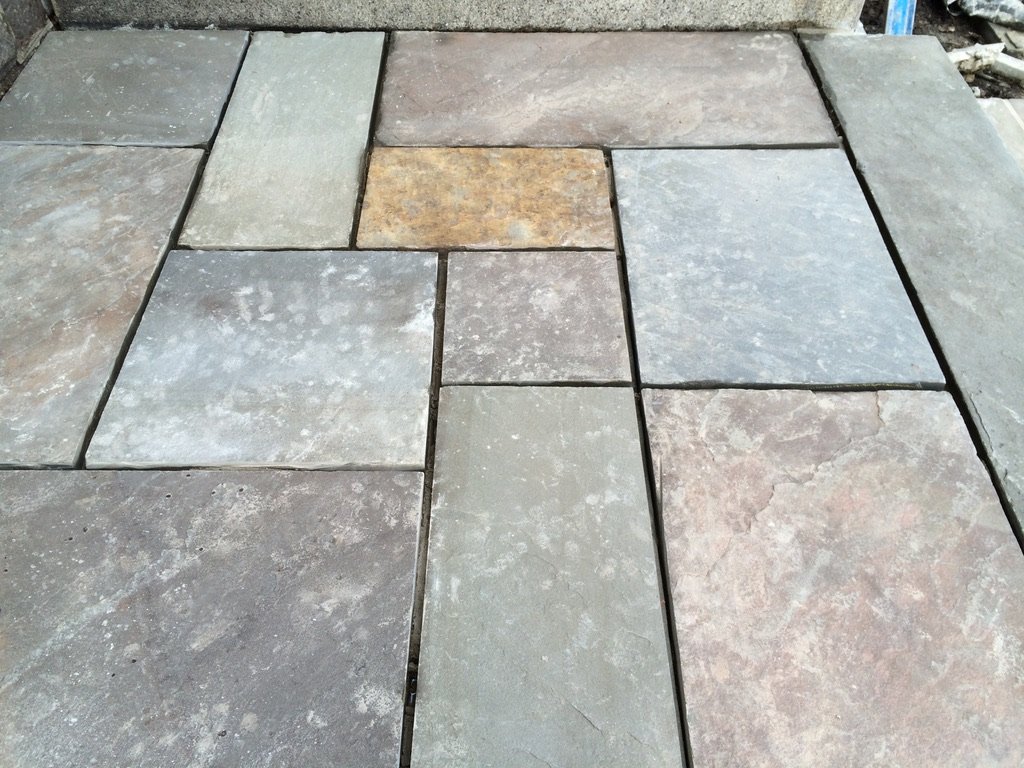
As you can imagine, the difference in final appearance between cut stone and flagstone is immense. Flagstone gives an irregular, rustic look to paved areas, while cut stone provides a much more polished, urban feel. While you occasionally do find flagstone used for paving outdoor living areas, I find that flagstone is best reserved for secondary walks and pathways and should not be used for expansive seating areas. Anyone who has ever tried to push back a chair while seated on a flagstone terrace will quickly understand why: the irregular surface of the stone makes for very rough going. As an added disincentive, irregular stones and slippery leather-soled shoes form a deleterious and dangerous combination in wet weather.
Finally, when choosing stone, don’t forget to pay attention to color. As is the case with brick, different hues will make an immense difference in the overall look and feel of your living area, and it pays to bring home a few samples from the stone yard to see how your selections blend with the materials already found on your property. Pattern also plays an important role in stone surfaces, but unless you’re using blocks of exactly the same size (a practice I don’t recommend due to the monotonous effect it often produces), determining the pattern for a stone patio or terrace is a complicated affair best left to professionals. Most stone yards offer a free design service; if you provide them with the exact dimensions of your space, they’ll come up with a combination of differently sized stone pieces that’s pleasingly random and varied.
So remember, if a new terrace or patio is on your agenda for this summer, the time to start planning is now—long before construction begins. The effort you spend resolving critical questions of size and materials will help guarantee that the perfect outdoor living space you’ve been dreaming about turns out to be just that—perfect.
A Brief History of the Patio
The terrace or patio (the words differ only in etymology and are used synonymously) is a relatively recent addition to the American landscape, at least in its current iteration. Arising from two sources—the covered porch and the paved atrium space common to houses in the Mediterranean—terraces became prominent landscape features only in the late Victorian era, and then only in large mansion-style homes. For most modest houses, a patch of grass served as both sitting area and play yard. It wasn’t until after WWII, and the ever-increasing popularity of outdoor living, that large paved areas became common in American backyards.