
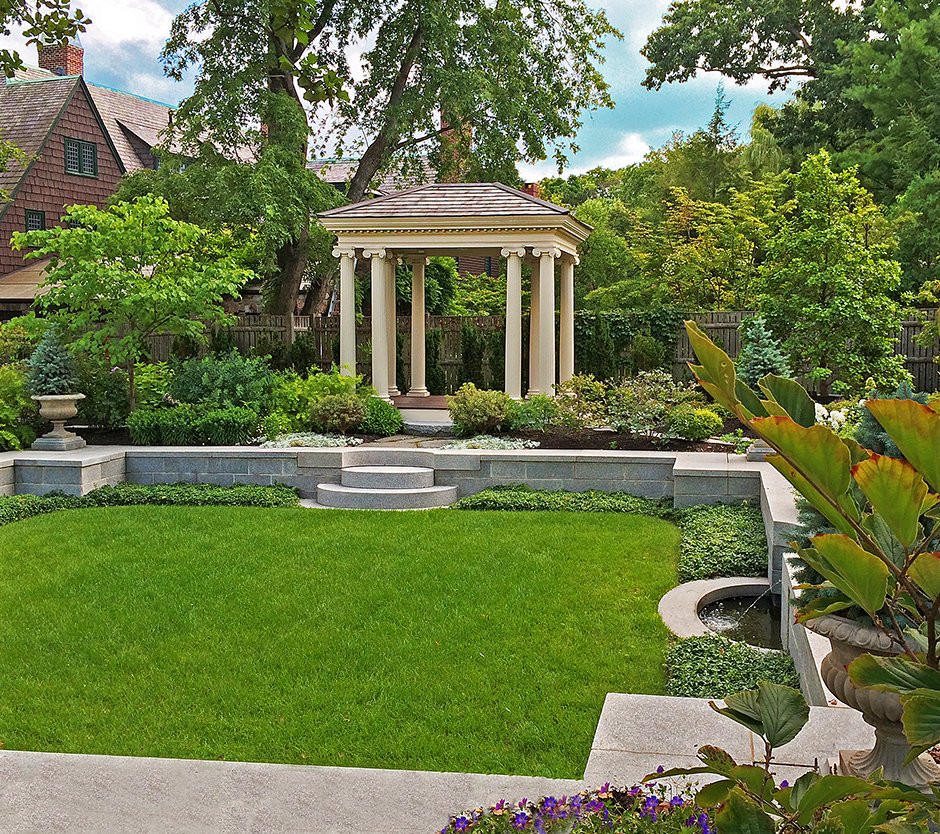
If you own—or are planning—a new home, chances are its architecture draws from a historic style. Neo-Georgian, with its white fronted columns? Adobe, long, low, and close to the earth? Shingle style, wooden and rambling, yet balanced in an asymmetrical way? What kind of gardens should surround structures like these?
Surprisingly, the answer may lie in a modified form of the formal garden—one that borrows the best elements of the past and adapts them for contemporary living. Think of it as a looser version of a style that was common a hundred years ago, before largely disappearing with the rise of modernism in the 1950s. Now, before objections arise, consider this: no word in the garden vocabulary is more misunderstood than “formal.” Almost inevitably, when I suggest a formal approach to a client, the response is, “Oh, we really don’t want anything too formal; the house—or our lifestyle—doesn’t warrant it.”
This almost instinctive reaction against formalism, I believe, stems from a modern American preference to avoid anything that might limit comfort or freedom. Over the past 50 years—mostly for the better—we’ve embraced a more relaxed way of living. So when the idea of a formal garden is raised, many people picture stiff gatherings of overdressed guests perched on unforgiving furniture, enduring endless afternoon teas.
Equally mistaken is the notion that formal gardens belong only to grand estates. In fact, the formal style was among the earliest used in this country, dating back to Plimoth Plantation and Jamestown. It has complemented homes ranging from modest country cottages to the great mansions of Newport.
Much of the confusion comes from the word “formal” itself, whose connotations have overshadowed its true meaning. In reality, a formal garden is simply one that—at least in its layout—emphasizes symmetry and order, rather than appearing entirely natural or wild.
The organizing language of these gardens is hardscape: walkways, fences, walls, gazebos, pergolas, arbors, balustrades, and stairs. This structure—ideally echoing the style and materials of the house—extends the built environment into the landscape, creating a framework that contains and enhances the plantings, much like a frame completes a painting. It also provides internal organization: a gazebo may anchor a vista, while paired pergolas can define the boundaries of a flower or vegetable garden.
At this point, you may still be thinking the result will feel too fussy or rigid. Not necessarily. The geometric relationships between house and garden are most apparent in plan view. On paper, the bones—paths, terraces, focal points, pools—can seem strict and orderly. But planting tells a different story. It can be as loose and abundant as a cottage garden—which, despite its natural appearance, often rests on a surprisingly formal structure—or as precise and restrained as Versailles.
It’s also worth remembering that nature’s first instinct is to soften edges. Almost immediately, lines begin to blur: soil spills over edging, plants creep and spread, surfaces develop patina. The composition gradually relaxes. This softening is part of the design—but if you begin with something too loose, it can quickly become shapeless. Start with strong geometry, and over time you’re far more likely to achieve that ideal balance: a controlled, harmonious abundance.
This is the essence of what might be called the New Formalism: embracing the unity and clarity of architectural garden design while adjusting both structure and planting to suit your lifestyle. If you prefer crisp box-edged beds with fountains and borders, you can have them. If you favor open space and a restrained palette, that works too. The key is not to reject formal design out of hand because it seems rigid. In the garden, you control the degree of formality—selecting from a wide range of architectural elements to suit your taste. What could be more satisfying than a garden grounded in timeless design principles, yet tailored to the way you live?