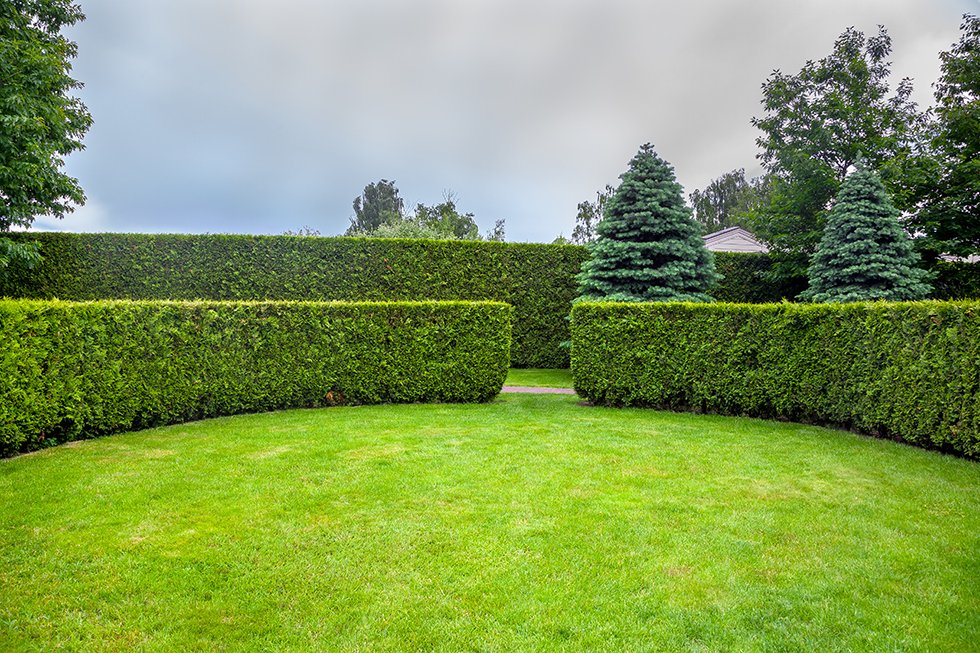
In these days of smaller and smaller lots and ever more congested living conditions, often one of the most important aspects of garden building is creating a sense of privacy. While it’s important not to hide so much of our gardening efforts behind high barriers that the public spaces of our landscapes, especially our front yards, become barren and boring, other areas of the garden, especially in the back, need to be confined from the prying eye. In these areas, one of the easiest and most economical solutions to achieving this privacy is the much-used, and much-abused, hedge. Very few other elements of the garden can either be so successfully or so miserably accomplished.
While hedging would seem a rather straightforward affair, successfully designing, planting, and maintaining a hedge can be surprisingly tricky. One of the most commonly made errors begins right at the design stage, and it is the same one made with fences—the lack of a logical beginning and ending point. Hedges, which are nothing more than a single species planted in a line, essentially form a living, breathing garden fence, and as such, they need to start and terminate at some point that completes the containment of a particular area, just like a fence would. Often, though, you will see a twenty-foot line or so of hedge dangling in space: one that starts and finishes in the middle of nowhere, simply because it was convenient at that point to block out some unpleasant view. This is an incorrect use of hedging and one that should be avoided at all costs. In a situation like this, a better idea would be to use an island planting of various different materials; its irregularly shaped massing, along with the contrasts caused by different foliage textures and colors, would yield a much more pleasing and natural aspect to the garden as a whole.
Another often overlooked consideration is the ultimate size of the screen required and its scale relative to the overall landscape. There is a hedging plant for almost every situation in the garden, from 40-foot-high beeches to foot-high rows of dwarf boxwood, and it pays to do your research before you start planting. Nothing looks sillier than a very tall hedge in front of a low-slung house like a ranch, especially when the five-foot planting the owners intended would have been just perfect. First ask yourself what you are trying to screen out. Is there a view you want to hide, or do you just need something low to delineate a particular space? Do you need a plant that will only grow ten feet high and stop, or do you need something higher? (Remember that views depend greatly on perspective, and you can often use a much shorter planting by positioning the screen closer to your vantage point.) Do you want a more formal-looking hedge sheared into a geometrical shape (lovely, but demanding), or are you going for a more natural, looser look? Are your privacy concerns seasonal? For instance, is the area in question only used during the summer? If so, you may only need to plant a deciduous border. (Deciduous plants have the advantage of having a far greater selection of interesting fruit, flower, and foliage possibilities than their evergreen cousins. Deciduous hedges are generally far less expensive to plant as well. The trade-off is, of course, that privacy is only provided for half of the year.) All of these questions need to be answered before you even think of picking up the shovel. There are plants appropriate for every one of these conditions, and an equal number that are not. Consulting a good guide, or an experienced garden professional, will save you from making costly and laborious mistakes.
Consider, too, the ground space you have to donate to the hedge. Another reason hedges are often unsuccessful in the landscape is that little consideration is given not only to the ultimate height of the hedge but to its width as well. Many plants grow as wide as they are tall, and benighted homeowners who unsuspectingly plant such spreading varieties are left with a never-ending battle on their hands—if pruning shears aren’t kept constantly at the ready, the shrubs will inevitably triumph and take over the house—they, after all, have nothing to do but sit around and grow, an otiose luxury the busy weekend gardener can’t afford to match. The trick is to get the shrubs to grow only in the direction you want them to. If ground space is at a premium, look for upright varieties; they are often, though not always, labeled with the Latin columnaris (columnar) and are ideal for situations where height is required with little room for width.
Another common error is not considering the growing conditions along the entire line of the proposed hedge. Unlike fencing, which is obviously indifferent to growing conditions, hedges require uniform light, fertility, and water conditions along the full line to achieve the best effect. For instance, many times you will see a line of some shrub such as privet which passes under a tree for part of its distance. The area in the sun is thick and glorious; under the leaf canopy, the growth is inevitably bedraggled and thin because these shrubs receive a fraction of the light and water that their more fortunate, better-located cousins do. There is no way that such a hedge will ever succeed—the shaded section will always look ragged and unkempt. There are two possible responses to such situations, and both require the costly solution of getting rid of the old hedge. The first, replacing the old hedge with another, involves my grandfather’s hedging rule of the lowest common denominator: when selecting plants for any kind of grouping, make sure that whichever is chosen will successfully tolerate the worst conditions along the line—anything the plants receive in addition to their minimum requirements will then be just an added bonus. The problem with this solution is that the better-placed section will still grow faster and fuller, and require additional pruning to balance the slower-growing areas. The other, and better, solution would be to call a spade a spade and, if practical, use a fence.
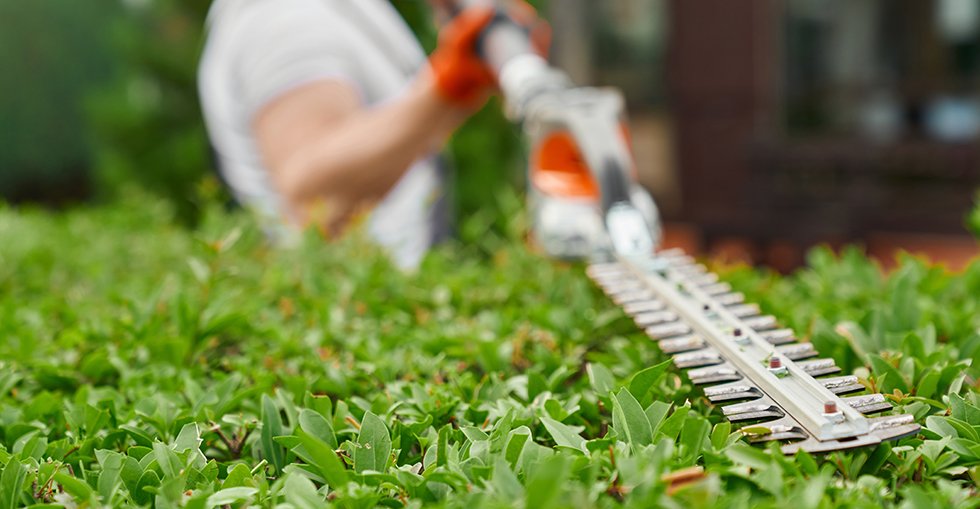
Finally, if your hedge is the type which you shear to keep thick, be sure to pay attention to the way in which you trim it. Many a good hedge is ruined by not following this simple rule: to remain full, hedges should be trimmed to be wider on the bottom than on the top. To some extent, the reason people fail to do this is that they are simply following the natural lines of the shrub. Many hedging materials such as box or privet are naturally wider at the top or in the middle than they are at the bottom. Left to themselves, the plants have a tendency to shade out their own lower growth as they age. While this matters to the plant not a wit, for the hedge owner this can defeat the entire purpose of the line when large unsightly gaps appear. The problem is compounded by many gardeners shearing to this natural line of the shrub, which creates even denser growth to further shade out the lower leaves. Instead, follow the old practice of “battering” a hedge: shearing it so that the base is wider than the top, allowing light to fall equally on all branches. This will ensure thick, uniform coverage over the entire surface of the plant. And while on the subject of pruning: if you have inherited an old deciduous hedge that is barren at the bottom, you can often rejuvenate the planting by cutting the hedge down in the fall to six inches or so above the ground. While this may sound rather drastic, many plants respond very well to such treatment, and in any case, it’s the only way to force a plant to re-leaf its lower reaches. An established planting such as privet, lilac, or spirea will often rebound to its former height in a few short years, much thicker for its radical haircut. One important note, though: this method only works for certain deciduous plantings. Evergreens must be slowly reduced over a period of years, a few inches at a time, once a season—just after the first flush of new growth. More rapid reductions will often result in the death of the plant.
Well-kept hedges can be a glory of the landscape, providing year-round architectural interest to the garden and a comforting sense of privacy. Improperly done, though, they are an eyesore that only makes you long to get out the loppers. Thorough planning before planting, and proper maintenance after, are generally the deciding factors as to which will be the case in your garden.
Deciduous Hedges
- Common lilac (Syringa vulgaris) provides classic spring blooms and dense summer foliage for informal hedges.
- Korean lilac (Syringa meyeri or S. pubescens subsp. patula) offers a more compact form suitable for smaller gardens or shearing.
- Tartarian honeysuckle (Lonicera tatarica), a fast-grower with vibrant spring flowers and attractive berries for quick privacy.
- Arrowwood viburnum (Viburnum dentatum), a strong native option that can grow into a dense seasonal screen.
- Highbush cranberry (Viburnum opulus var. americanum), useful for a taller hedge with good structure.
- Ninebark (Physocarpus opulifolius), tough, adaptable, and attractive in mixed or informal hedges.
- Northern red-osier dogwood (Cornus sericea), especially good where you want a thicket-like hedge and can tolerate some spread.
- Hydrangea arborescens or bigleaf hydrangea, if you want a looser hedge with flowers and summer coverage.
- American elderberry (Sambucus canadensis), fast-growing and good for a natural-looking screening hedge.
Evergreen Hedges
- Arborvitae (Thuja occidentalis), one of the best year-round privacy plants for the Boston area, especially in narrow forms.
- Eastern red cedar (Juniperus virginiana), a durable evergreen that tolerates salt, wind, and deer better than many choices.
- Inkberry holly (Ilex glabra), a native broadleaf evergreen that works well for foundation hedging and lower screens.
- Japanese holly (Ilex crenata), a dense, clip-friendly evergreen that can mimic boxwood in colder climates.
- Boxwood (Buxus spp.), best in sheltered sites; it gives a formal hedge but needs more care than arborvitae.
- Holly types such as winterberry’s evergreen relatives and other landscape hollies, which can provide dense structure and winter color.
Best Picks by Use
- For formal year-round privacy, choose arborvitae or Japanese holly.
- For native, softer screens, arrowwood viburnum or ninebark work well.
- For salt-exposed or roadside spots, eastern red cedar excels.
- For lower foundation hedges, inkberry holly or boxwood suit protected sites.
Important Practical Notes
In Boston’s climate (USDA zones 6-7), site conditions matter greatly—match plants to sun exposure, winter winds, deer pressure, and salt. Deer often browse lilacs, honeysuckle, arborvitae, and boxwood, so use repellents or deer-resistant picks like eastern red cedar or ninebark. Mixed hedges boost resilience over monocultures.