There’s a certain fatigue evident in the fall garden: the heat of summer has long since burned away the green vibrancy of spring; the light turns golden, soft and attenuated; most perennials, shrubs, and trees, having finished their floral labors, begin a grateful descent toward dormancy. Often, there’s a certain fatigue evident in the autumn gardener as well—at least there is for me. Try as I might to maintain my horticultural enthusiasm, after a long spring and summer season of weeding, watering, pruning, and primping, I’m pooped. Though I’m well aware that fall is a wonderful time to make improvements to the borders, many’s the year that those autumn catalogues with their smiling seas of scintillating new bulbs and perennials beckon in vain. I know the garden will be poorer from my lack of effort, but I just can’t muster the energy to turn over another spadeful of soil—until next spring, that is, when my passion for gardening returns almost simultaneously with the first warm, sunny days.
Fortunately for lazy gardeners like me, Mother Nature offers an easy solution for those who want their gardens to continue to look great through the fall with little effort, and the answer lies in including a judicious selection of woody plants in your beds and borders. Unlike annuals and perennials with their constant maintenance demands, most woody shrubs require a major expenditure of effort only once, at planting time. After that, a handful of fertilizer and a quick annual pruning are all that’s required to keep the plants looking good. Here’s a selection of my favorite woody shrubs for the fall garden, guaranteed to add a bit of effortless vim and vigor to your landscape.
Hydrangeas
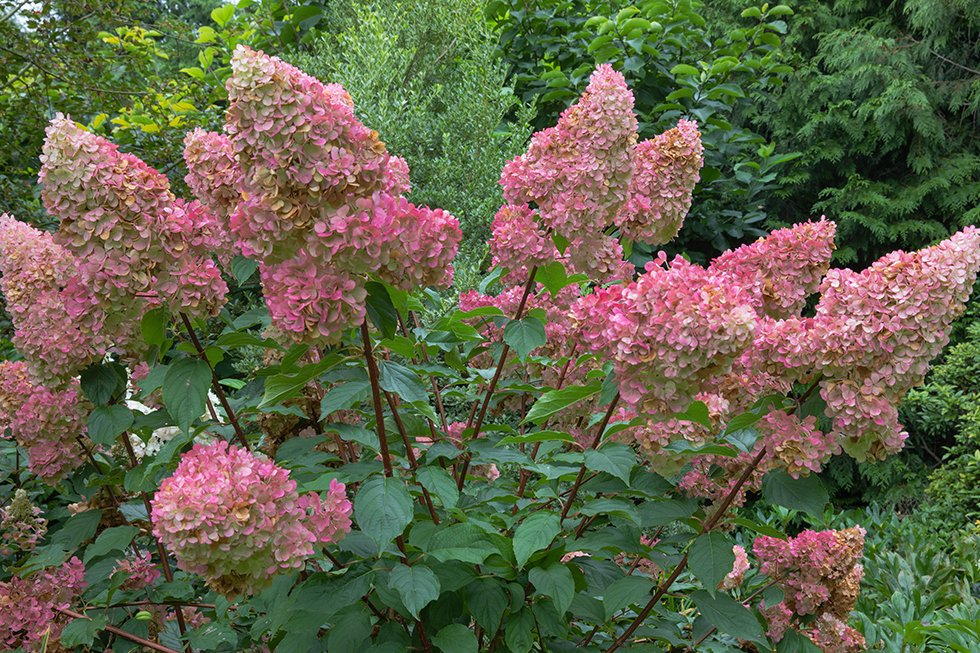
- Anyone who has an old-fashioned garden, or who knows someone who does, has probably seen one of autumn’s stars, Hydrangea paniculata ‘Grandiflora,’ peegee for short. This shrub was hugely popular with the Victorians, and deservedly so, as it covers itself every fall with gigantic flower heads in a unique mixture of chartreuse, rose, and cream that last for months outdoors, or can be cut and dried to make fantastic indoor arrangements. The peegee’s only drawback is its size: mature specimens can easily reach 15 ft, and the flower heads are often so large that the entire bush becomes overly pendent, especially when the blossoms are weighted with water. Lately, however, breeders have been doing considerable hybridization with this species and have produced some spectacular new varieties. A real favorite is H. paniculata ‘Limelight’ (Zones 4–8), which grows only 6–8 ft tall and keeps its lovely greenish-pink flowers erect through the fall. I have this particular shrub in my own garden, and it has truly become one of my preferred autumn plants. There’s another recently introduced variety I really love: H. paniculata ‘Pinky Winky.’ Despite the silly name, this hydrangea is a knockout: cream flowers continue to open on the tips of long trusses for weeks, while the older flowers change from white to light pink to rose.
Viburnums
- Despite the fact that viburnums are native to most of the Northern Hemisphere, these flowering shrubs are strangely neglected in our gardens. Certain types, mostly those noted for their incredibly fragrant spring bloom, such as Viburnum carlesii, are seen occasionally, but the rest of this clan remains MIA in America. This is extremely unfortunate, because viburnums truly are the stars of the late summer and fall garden—not so much for their flowers (which are spectacular but occur mostly early in the season), but rather for their absolutely show-stopping display of colored berries and fall foliage. Particularly noteworthy are V. dentatum ‘Blue Muffin’ (Zones 3–9), which yields clouds of bright blue berries followed by yellow and red foliage in fall; V. dilatatum (Zones 4–7), which covers itself with thousands of red berries that often persist into winter; and V. nudum ‘Winterthur’ (Zones 5–9), which has blue-black berries in late summer followed by maroonish-purple foliage in fall. Like all viburnums, these selections have a multi-branched, upright, mounded habit, moderate size, and excellent disease tolerance.
Deciduous Holly
- Another notoriously neglected berried wonder is Ilex verticillata, commonly known as deciduous holly. These shrubs are so unprepossessing for much of the season that for many years I never paid them much heed: in spring they bear tiny white flowers, and in summer a full cloak of plain green leaves. But come autumn, watch out! Once the first frosts have done their work and removed the obfuscating leaves, the stems are revealed in all their glory—covered with greenish berries that, depending on the variety, soon turn shades of yellow, crimson, or red. Planted in masses along woodland edges or in the damp, partially shady places they adore, the shining berry clusters are visible from hundreds of feet away. Strangely, the very vibrancy of the display forms my sole objection to deciduous hollies: the berries are so lovely, and so well advertised, that they attract flocks of wild turkeys to my backyard. On other occasions a treat to behold, these birds arrive ravenous and soon reduce the clusters—normally persistent for months—to a few paltry remnants within days. Witnessing this desolation from my kitchen windows every fall, I must admit that my temptation to switch to wild turkey for our annual Thanksgiving feast grows with each passing year.
Dogwoods and Willows (“Stickies”)
- Finally, there’s a group of shrubs I jokingly call the “stickies,” members of the dogwood and willow clan that are not planted for their flowers, foliage, or berries, but rather for their stems, which turn brilliant yellow and red in late fall and winter. If you have a bit of space and are floristically inclined, these shrubs are garden essentials, as their starkly sculptural twigs are expensive to purchase and de rigueur in seasonal arrangements. Particularly useful are Salix alba ‘Britzensis’ with crimson stems; Cornus sericea ‘Flaviramea’ with yellow; and Cornus alba ‘Sibirica’ with red. All are hardy in Zones 3–8 and are practically maintenance-free. The best-colored stems, however, come from new growth; thus, rigorous annual removal of old woody branches is essential for optimal color.
So this autumn, if you’re feeling a bit of garden malaise, take heart: there’s no need for that perennial dash to settle the borders before the snow flies. Simply include a few of these autumnal woody showstoppers in your landscape, and next year, sit back, put your feet up, and enjoy!