One of our design specialties, and one closest to my heart, is the country garden. There’s something profoundly grounding about the simplicity and authenticity of rural landscapes — the way they connect us to the rhythms of nature and remind us of the quiet beauty that lives in everyday places. I suppose my affection for this style is rooted in my own childhood. I grew up in Wisconsin, land of field and farm, where every season brought its own transformation: the green swell of summer pasture, the gold of autumn stubble, the crisp, white hush of winter. Though I’ve now been a Bostonian for more than thirty years, those early scenes still shape how I view the world — and how I design within it. My rural roots remain a steady influence, guiding me toward an approach that values honesty, craftsmanship, and natural harmony over ornamentation or excess.
Several years ago, we completed a project that beautifully expresses this philosophy — a country garden created for a renovated barn in Sudbury, Massachusetts. The barn, once home to sheep, had been thoughtfully restored into a charming residence that retained much of its original character. Our challenge was to design a landscape that honored that heritage without overwhelming it. In keeping with the spirit of the place, the treatment was entirely simple, meant to feel as though it had always belonged there, shaped more by time and nature than by human intervention.
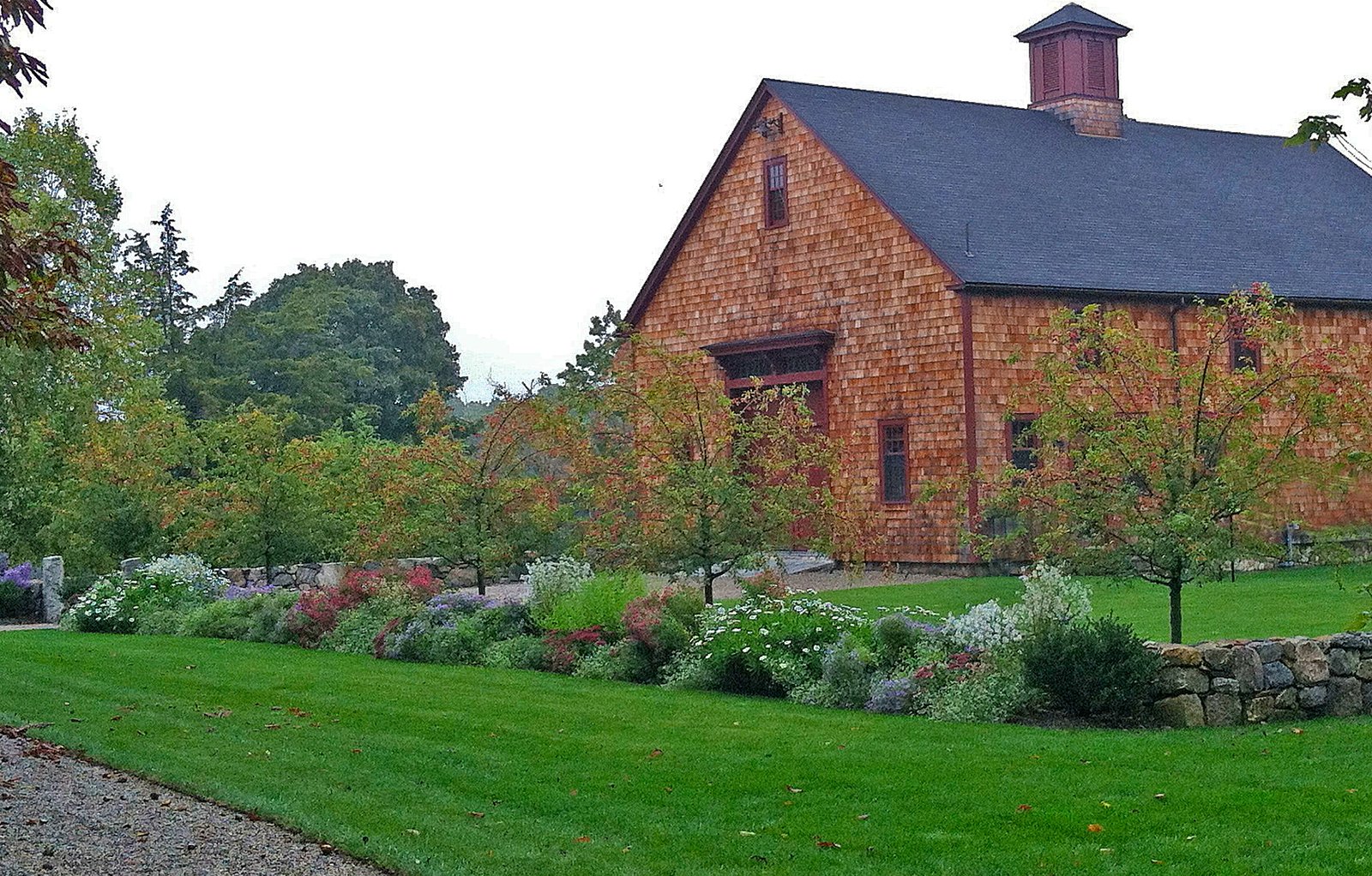
To create a sense of enclosure and continuity, we designed what we called a “paddock” around the former sheep barn, loosely defined by a low stone wall. The stone was local — rough-hewn, imperfect, and full of quiet strength — chosen specifically to echo the agrarian traditions of rural New England. Rather than trying to impose symmetry or formality, the walls follow the land’s natural contours, as if they had grown out of the soil itself. Within this boundary, we wanted a sense of life and movement, something that would mark the seasons and draw the eye gently upward. So we chose flowering crab apples to punctuate the wall line, their spring blossoms offering a delicate counterpoint to the rugged stone. Later in the year, their rosy fruit brings subtle color and texture to the garden, sustaining interest well into the colder months.
Facing the front of the property, we added a generous perennial border that bursts into its full glory in autumn — precisely when the owners are most often at home to enjoy it. This timing was deliberate. Great gardens, after all, should not just be beautiful; they should be personal, aligning with the lives and habits of those who inhabit them. The border features warm, rich tones: deep asters, russet-colored rudbeckia, golden grasses catching the last of the season’s sunlight. The composition was designed to evoke the bounty and nostalgia of the New England fall garden, when color intensifies just before the landscape slips into dormancy.
The photograph shown here was taken in October, during that vibrant and fleeting moment when everything seems to glow with its own inner light. It captures not just the beauty of the plantings but the spirit of the place — a tranquil blend of cultivated and wild, past and present. The paddock area, once pasture, now serves as a graceful games lawn. Its size and open simplicity make it a versatile space, perfect for croquet, volleyball, or the occasional elegant garden party. Yet even in its recreational form, it retains the underlying humility and natural rhythm of its setting, remaining true to its farming origins.
This garden in Sudbury stands as a reminder that rural design, when approached thoughtfully, can be both timeless and deeply personal. It speaks to the enduring charm of the country landscape — its balance of structure and freedom, of memory and renewal. For me, each project like this is a chance to reconnect with those Wisconsin fields of my youth while celebrating the New England countryside I now call home. The result is not just a garden, but a living reflection of place, history, and heart — one that continues to tell its quiet story through every passing season.