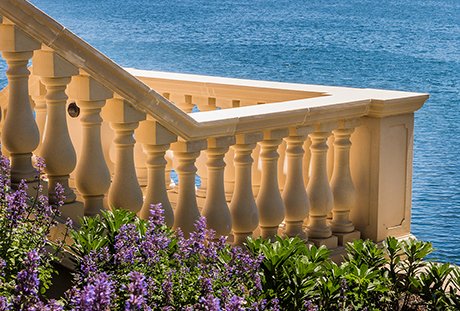
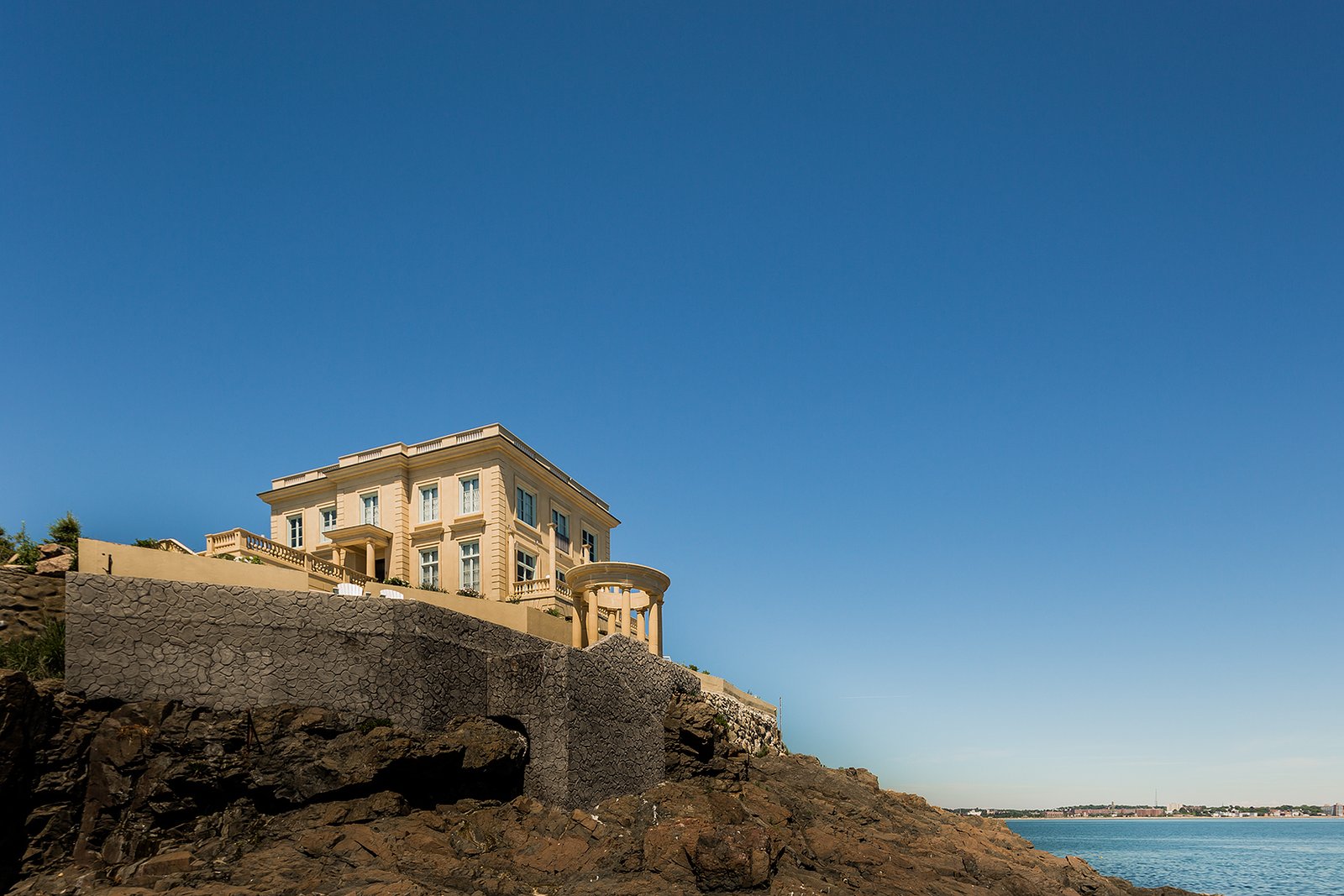
This dramatic North Shore seaside garden ranks among the most technically demanding and design-challenging projects we’ve ever undertaken. Perched on an exposed granite outcropping, the Mediterranean-style residence required a landscape that could stand in dialogue with its neoclassical rigor while softening its architectural form and connecting it gracefully to the rugged Atlantic below. The challenge was to create order within nature’s force—to celebrate the sea while protecting against it.
The site itself dictated much of the design approach. With the house sitting atop solid bedrock, the landscape offered few opportunities for planting directly into native soil. Every planting bed, terrace, and retaining wall had to be carefully engineered, carved, or constructed to accommodate soil depth, drainage, and access. Working in close coordination with our partners at S&H Construction, we devised a classical stair and wall system that guides visitors down 100 feet of grade change—through four distinct garden levels—culminating in a sculptural ocean stair lapped by wind and wave. Precision was critical: tolerances measured in fractions of an inch determined whether runoff would flow away from structures or compromise their integrity.
 Building a garden in this kind of coastal environment demands an intimate understanding of two often-opposing forces: aesthetics and endurance. Salt spray, intense winds, and constant exposure to sun and storm quickly eliminate the possibility of delicate plantings or fragile materials. Plants had to be selected not only for their visual compatibility with the Mediterranean architecture, but also for their ability to thrive in lean, sandy soils inflected with salt. Hardy evergreens like Juniperus conferta and Pinus mugo provide backbone and year-round structure, while gray- and silver-leaved perennials—Lavandula angustifolia, Santolina chamaecyparissus, and Perovskia atriplicifolia—echo the color of the surrounding granite and sea mist. Lower terraces closer to the water’s edge feature tough groundcovers like seaside goldenrod and beach grass to stabilize soil and resist erosion.
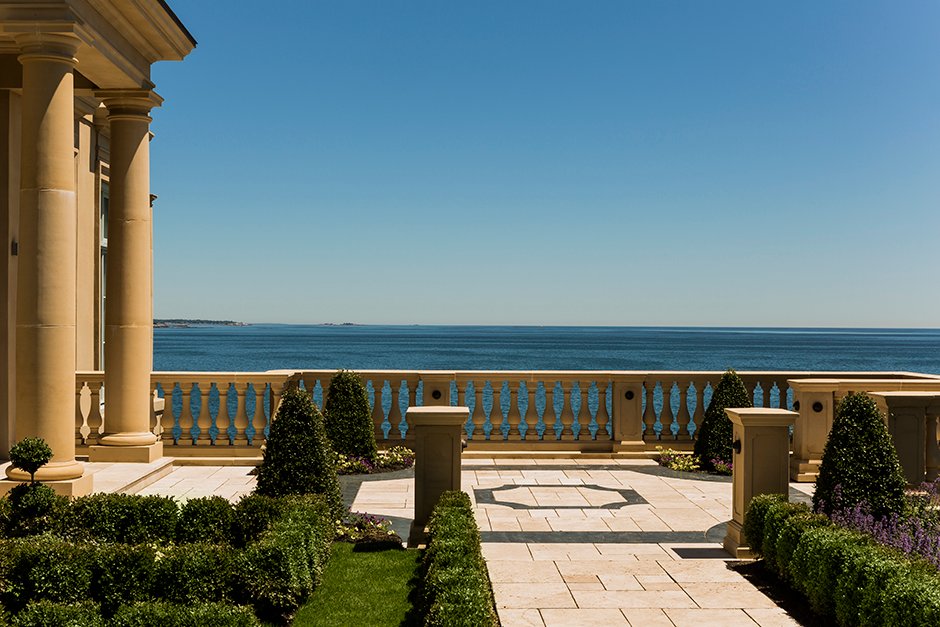 Another key challenge lay in reconciling the formality of neoclassical geometry with the irregularity of a natural shoreline. Straight lines and precise curves must coexist with unpredictable tides and shifting light. The staircases and terraces were proportioned using classical ratios, ensuring harmony with the architectural façade, but surfaces were intentionally varied with local stone to root the design in its New England context. The resulting progression—from formal upper terraces framed in limestone to looser, more naturalistic plantings below—mirrors a descent from civilization to nature, from architectural order to elemental wildness.
The technical engineering behind the beauty was no less demanding. Anchoring walls into bedrock required custom-drilled foundations and hidden drainage systems to manage stormwater. Every joint, conduit, and planting cavity had to be waterproofed against salt intrusion. Even logistical access posed difficulties: all materials—stone, soil, and plants—had to be craned or hand-carried down multiple levels of temporary scaffolding. Coastal permitting and environmental protection laws added another layer of complexity, requiring thorough documentation to safeguard native habitats and prevent shoreline disturbance.
Despite these challenges, or perhaps because of them, the final result feels inevitable—as if house, garden, and sea always belonged together. Visitors descending the classical stair experience a gradual unveiling of views: the upper levels maintain a sense of enclosure and formality; the middle gardens open to framed glimpses of horizon; and the final descent yields full immersion in the sensory drama of ocean and sky. At the lowest landing, where wind and salt saturate the air, one feels both exhilarated and humbled by the raw energy of the Atlantic.
Creating a garden at the edge of land and sea is as much an act of respect as design. It requires patience, restraint, and technical mastery—an understanding that beauty here is not imposed, but negotiated with nature’s terms. This project stands as a testament to that balance: a place where architecture’s precision and the sea’s volatility coexist in dynamic equilibrium, transforming a difficult site into a timeless retreat.