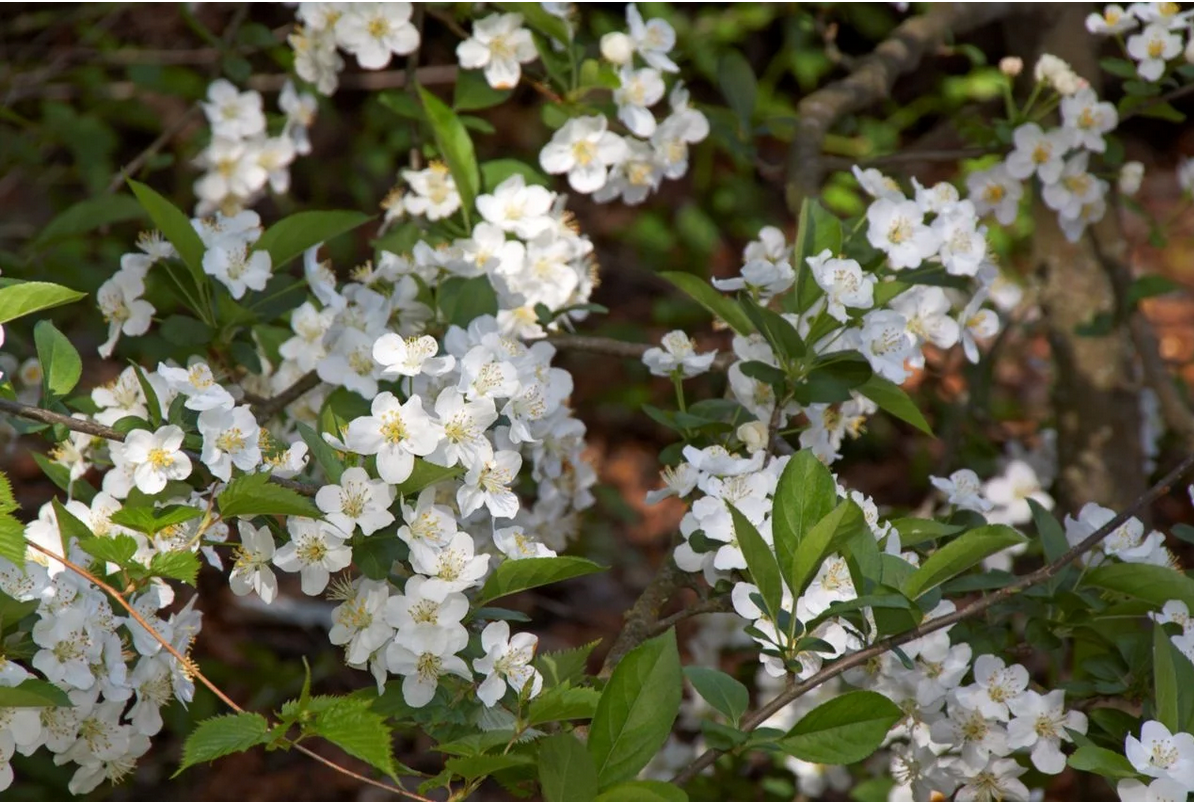
Those of you who read this column regularly know that I pretty much learned to garden at the knees of my grandfather. Gramps had a wonderful yard, with wide lawns and long borders of iris and daylilies, and perhaps most importantly for a young boy, a collection of large, mature trees—perfect for climbing. Of these, my favorites were the four huge crabapples that framed the back garden, which my grandfather had specially pruned just to accommodate my penchant for arboreal perching. Each spring, when their long-awaited blossoms burst forth and filled the air with the most magnificent scent, I would climb high up to the topmost branches, where you could look over the houses and yards and roads all the way to the distant shores of Lake Michigan. There I would sit for hours, surrounded by a scented mist of pink blossoms and the gentle hum of bees, sinking into a fantastic reverie of future deeds and dreams, until my grandfather would arrive from some other part of the garden to make sure that I hadn’t become so intoxicated with the sweet fragrance as to fall out of the tree. It’s not surprising, then, that crabapples have always held a special place in my heart—and in my gardens.
Getting Started with Crabapples
If you are unlucky enough not to have struck up a similar acquaintance with crabapples in your backyard but would like to, there are a few things you should know before you get started. First of all, you’ll need a spot in full sun with good drainage and reasonably fertile soil, in Zones 3/4–8/9. Next, you’ll need to choose a variety. While this may sound like a fairly simple exercise, it’s not. Unfortunately for the novice, the crabapple family (Malus spp.) is huge, having been intensively bred over the last century and now numbering in the many hundreds, if not thousands, of cultivars.
Thus, selecting one or two for your yard from all these choices can be a bit daunting. The easiest method is by process of elimination, choosing among the species’ principal characteristics. For instance, crabapples can be grouped by:
- Tree size/shape – Crabapples range from 40′ × 30′ giants to shrub or bush forms, including weeping, columnar, and spreading varieties in all sizes.
- Flower color – Flowers come in every shade from the palest white through pink, red, and purple-red. Note: some crabapples only bloom semi-annually or, at best, put on a poor show every second year. Look for varieties with good annual bloom.
- Fruit color/size – Crabapples have traditionally been distinguished from apples by their fruit size, which ranges from about 2 inches to a quarter of an inch. Those interested in feeding birds should choose the smaller-fruited varieties; those interested in harvesting the crop should choose the largest-fruited cultivars. The fruits themselves also vary in color, from yellow through orange to red, as well as in persistence—i.e., how long they remain on the tree into the fall and winter.
- Fragrance – Not all crabapples are equally fragrant; in general, the original species forms are the most scented, and the double-flowered cultivars the least.
- Disease resistance – Crabapples are no more disease-prone than most ornamental trees, though they are unfortunately susceptible, like their apple cousins, to problems such as fire blight, scab, and cedar-apple rust. Many, though not all, modern cultivars have been bred to resist these diseases.
Which variety you ultimately select will depend on your personal tastes as well as the amount of space you have to dedicate to the tree. Consult a good guide or local nursery to help whittle down your choices.
Favorite Crabapple Varieties
Here are a number of my personal favorites, all with average to good disease resistance, fine annual bloom, and excellent berries.
Malus ‘Blanche Ames’
This 20-foot spreader with a slight weeping habit has very pale pink blossoms that open to become semi-double, filling the tree with flower. The fruit is small (0.3 inches) and yellow.
Malus ‘Doubloons’ This upright spreader will reach a size of 15 × 10 feet; the white semi-double flowers form bright yellow 0.5-inch fruits that persist well into November.
Malus ‘Donald Wyman’ One of my very favorites, this 20 × 20-foot crab blooms with a profusion of pink buds opening to white flowers, followed by glossy red 0.4-inch fruit that, here in Boston, often persists well into February, providing a terrific addition to the winter landscape.
Malus ‘White Cascade’ For those of you who thought that cherries have the corner on beautiful weeping forms—think again. ‘White Cascade’ is a graceful weeper, growing to 15 feet. Its white flowers mature into yellow-green 0.4-inch fruit, excellent for smaller gardens.
Malus ‘Almata’ Though technically an apple, this striking red-fleshed apple cultivar was developed by Dr. Nels Hansen and is closely related to the red-fleshed crabapple Malus niedzwetzkyana. This semi-dwarf tree, typically reaching 14-22 feet on MM106 rootstock, produces small, round-conical fruits about two inches in diameter with deep pink to red flesh, smooth wholly red skin, and a sweet-tart flavor. Hardy to Zone 3 (-40°C), it features attractive flowers and foliage but requires a pollinator as it’s not self-fertile, with average disease resistance including some susceptibility to scab and fire blight. Ripening in October, ‘Almata’ is ideal for cooler climates and northern gardens.
Sidebar: Cooking with Crabapples
The large-fruited crabapples are perfect for use in jellies and jams, especially because their high natural pectin content makes jelly production almost automatic. Crabapples are also great in pies, in lieu of standard apples, and can be pickled as well. Having heard reminiscences of wonderful crabapple confections from my dad, I consulted with the good ladies of Fifield, Wisconsin, my father’s home, where crabapples have a long tradition of good eating. The following recipe, adapted from a 1920 cookbook, makes an easy, delicious jelly that’s sure to please.
Crabapple Jelly Recipe
Ingredients
8 cups fresh crabapples
Water, as needed
3 cups white sugar
1 cinnamon stick (optional)
Directions
-
Remove the stems and blossom ends from your crabapples, and cut them into quarters. Place them in a large stainless steel or other non-reactive pot or saucepan, adding just enough water to be visible, but not so much that the crabapples easily float. (Add the cinnamon stick if desired.) Bring the mixture to a boil, reduce heat, and let simmer for 10 to 15 minutes. The apples will soften and, depending on the variety, change color.
-
Strain the apples and juice through 2 or 3 layers of cheesecloth, or use a food mill. You should have at least 4 cups of juice. Strain and discard the pulp, and pour the juice back into the pan. Bring to a simmer and cook for 10 minutes, skimming off any foam. Stir in the sugar until completely dissolved. Continue cooking at a low boil until the temperature reaches 220–222°F (108–110°C). Remove from heat.
-
Pour the jelly into sterile small decorative jars, leaving ¼ inch headspace. Process in a hot water bath to seal as you would any other type of canning product.