
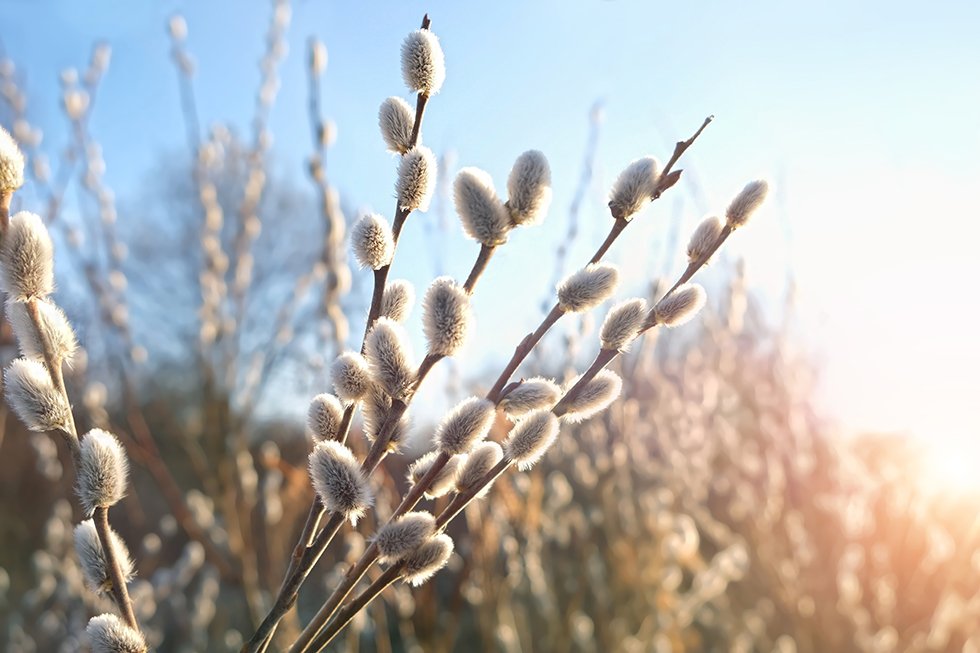
One of my earliest and fondest gardening memories is of the pussy willows in my grandfather’s backyard. There stood a clump of what Gramps always called “French” willows, which bore the most incredibly large, cottony catkins—far bigger than any I had seen before. On our Saturday morning walks through the garden in late winter, this bush inevitably formed the culmination of our tour; we would pause here for a moment while Grandpa inspected the catkins. Most often, the result was just a disappointed shrug, but finally there would come the day when Grandpa could merrily intone, “Yes, Michael, I do believe the buds are starting to swell.” If sufficiently advanced, a number of branches would be cut to take indoors to my invalid grandmother—the first sign, despite the snow on the ground and blustery winds from the north, that spring would in fact return and release us from the seemingly endless cycle of cold and ice that forms a Wisconsin winter.
To this day, I still appreciate the prognosticative nature of pussy willows, and I have always managed to include at least one specimen in any garden I’ve kept—even the tiny 10 × 20 city plot I maintained just after college. But recently, thanks to introductions from the Far East, things have begun to change in the willow world. A number of new varieties have appeared on the scene that make the plain green leaves and gray catkins of my youth seem rather mundane. Species with much larger or tinted catkins, colored branches, or even variegated leaves are now available to charm even the most skeptical gardeners. Here are a few of my favorites:
Salix chaenomeloides — The giant pussy willow is a considerable improvement on the standard pussy willow (Salix caprea) we’ve traditionally seen in our yards. (S. caprea was Gramps’s “French” willow, itself a better variety than Salix discolor, which is native to much of the U.S.) The giant pussy willow has dark red buds on mahogany branches that open to grayish catkins with a pinkish tinge. To 20 ft; Zone 5.
Salix gracilistyla ‘Melanostachys’ — The black pussy willow lives up to its name: jet-black catkins appear before the bright green leaves and are perfect for forcing. A broad shrub; 15 × 15 ft; hardy to Zone 5.
Salix fargesii — I first spied this delightful willow on a tour of the VanDusen Botanical Garden in Vancouver and eventually persuaded the staff to allow me to take some cuttings. The sight of this shrub’s purplish-red stems covered with large reddish buds is one of the prettiest in a late-winter garden. 10 × 10 ft; Zone 5.
Salix integra ‘Hakuro Nishiki’ — This showstopper is grown not so much for its delicate catkins or red stems, but for its foliage. The cream, green, and pink variegation adds a dash of color to the landscape on even the dreariest day. Zone 4; 6 × 8 ft, though best kept smaller and cut back hard each spring for optimal color.
Last fall I heard about another variety, Salix magnifica, with large, magnolia-like bluish leaves and burgundy stems, which I intend to track down through mail-order sources and add to my ever-growing willow collection—a practice I most heartily recommend if, like me, you long for such exquisitely beautiful harbingers of spring in your garden.
Pussy Willow Culture
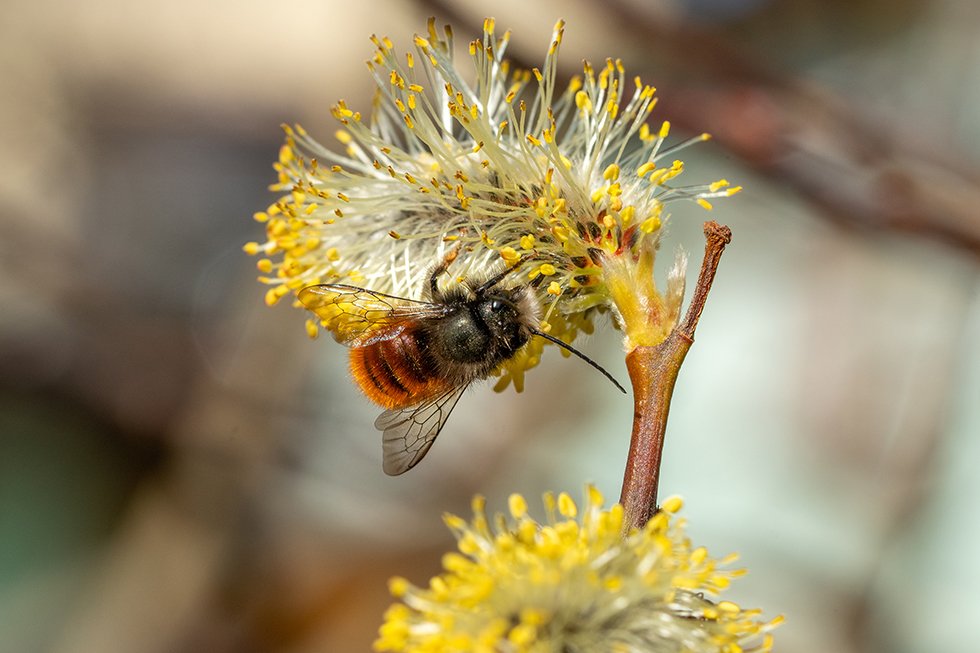
Pussy willows, as a group, are remarkably easy to grow. Like their willow relatives, they generally prefer moist sites—many even enjoy growing with their feet in the water. They prefer full sun, though they will tolerate some shade. Most are quite hardy, many to Zones 4/5–8/9. One peculiarity is that they generally bear male and female catkins on separate plants. As the male catkins are almost invariably larger, it pays to buy plants early while the catkins are still visible—otherwise, the plants are indistinguishable. Plants grown for forcing branches should be cut back by half every 2–3 years just after flowering to promote new growth and larger catkins.
Using Pussy Willows Indoors
Pussy willows are perfect for forcing and can be cut and brought indoors anytime after January. They are a fantastic foil for cut flowers (I particularly like them mixed with lilies). If you wish to preserve the catkins intact, however, keep the branches in water only long enough for the catkins to emerge, then remove them and place them in a dry vase. Any left in water will soon flower and may even begin to root—a happy occurrence if you’d like to pass along a new plant to a friend.