“A rose by any other name,” my grandfather used to recite, “is still a pain,” having himself entirely eschewed the genus many decades before I was born to concentrate on his great growing passion, the German iris. (A plant which, to my way of thinking at least, is as much—or even more—of a pain than the rose, an opinion I never dared utter in his presence.) To a large extent, though, especially given the era, Gramps was spot on: for after the Second World War, the gardening world became enamored of that glorious prima donna, the tea rose. While the ancestors of the tea rose had been hardy and industrious types, growing and blooming without any particular concern or care, postwar tea rose cultivars turned out to be an exceedingly finicky breed. Rarely has a single plant demanded so much from the gardener and tolerated so little. Potential problems—with their costly and environmentally unfriendly solutions—from black spot to powdery mildew to aphids to constant demands for water and fertilizer were enough to overwhelm all but the most dedicated gardener. This was on top of the fact that, while the bewildering array of new introductions was surely beautiful, by and large these new cultivars had lost what to many was the most important rose characteristic of all—their heavenly scent. It was no wonder Grandpa didn’t bother with roses, and for many years, neither did I.
Then, in the ’80s, things started to change, due in large part to a dedicated band of rosarians here and abroad who managed to start nothing short of a rose “revolution”—a literal turning back of breeder and consumer interest to focus not only on existing antique varieties of hardy, carefree roses, but also on breeding new types, the so-called “new-old roses,” recent introductions that combined the best characteristics of old roses—hardiness, scent, and disease resistance—with new and exciting forms. The happy result is that these days, if you live in Zones 3–9, chances are there’s a reasonably undemanding rose for almost any site in your garden, even including that former demon of the rose grower—partial shade. This happy state of affairs has led to a considerable stretching of the rules for using roses in the general landscape. Over the years I have been experimenting with releasing roses from the confines of the traditional all-rose garden and placing them in different and unexpected settings around the yard—with great success. Here are three of my favorite new uses for roses:
Foundation Plantings
Part of the key to using roses in the general landscape is to realize that, by and large, they are shrubs, not merely large perennials, and should be used accordingly. As such, they deserve a place in general shrubbery planting schemes, especially around the foundation. One of the great failures of American gardening is the boring and monotonous plantings we have in front of our houses: mile after mile of lugubrious evergreens, relieved only by the occasional forsythia, burning bush, or other common-as-mud deciduous plant. Instead, why not try using shrub roses and clothe your home in flowers and fragrance rather than funereal foliage? Just make sure, when choosing roses for foundation plantings, that you select a variety that will stay an appropriate size and will flower in a color to complement your home. Some shrub roses can get quite big, and it won’t take long for the most vigorous types to overwhelm their space if you aren’t careful. Also, when looking for roses for foundation plantings, it’s important to select not only varieties with excellent bloom, but also those that have good-looking foliage that will remain attractive throughout the season: the albas (R. alba spp.) are an old-time favorite, with their arching foliage and scented flowers in white and pink. Gallicas (R. gallica spp.) also make good candidates, as do many of the repeat-blooming hybrid perpetuals, such as ‘La Reine,’ with its pink blossoms all summer, or ‘Frau Karl Druschki,’ which covers itself in white flowers. China roses, if your climate allows, are also excellent.
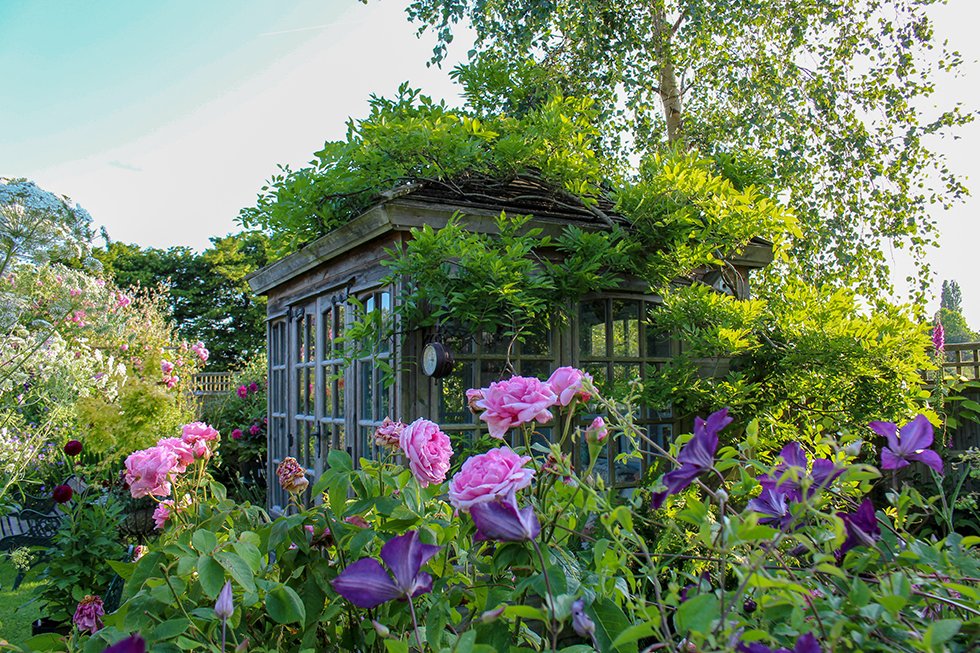
In recent years, a number of modern repeat-blooming shrub roses have proven especially valuable in foundation settings, combining continuous flowering with improved disease resistance and strong fragrance—qualities once thought mutually exclusive. Varieties such as Eau de Parfum exemplify this new direction: compact, well-behaved in habit, and producing wave after wave of richly scented blooms from late spring until frost. These newer introductions are particularly well suited to foundation use, where their tidy growth and consistent performance ensure they neither outgrow their welcome nor lapse into unsightly decline between bloom cycles. For the gardener seeking both reliability and romance, they offer perhaps the best argument yet for welcoming roses back into everyday landscape design.
Suitable repeat-blooming roses for Zone 6/New England foundation plantings include:
- Eau de Parfum
- Olivia Rose Austin
- Desdemona
- The Fairy
- Bonica
- Carefree Beauty
- Julia Child
- Easy Does It
- Flower Carpet Pink
- Quietness
Groundcovers
When most people think of groundcovers, they think ivy, pachysandra, and other types of low creepers, but there are many varieties of roses that only grow a foot or so tall and, with their rambling, spreading habit, make ideal full-sun groundcover plantings. Chief among these are the so-called “landscape roses,” which happily spread several feet in every direction and quickly form a dense flowering thicket. Groundcover plantings of these roses are especially effective when used with massed plantings of gray-leaved species such as artemisia or, one of my favorites, caryopteris, which forms a truly breathtaking display in August and September when it combines its blue flowers and gray foliage with the pink of rose blossoms. For my money, few roses can beat those of the Meilland family, especially ‘Bonica,’ ‘Carefree Wonder,’ and ‘Carefree Delight,’ which bloom continually all season and seem untroubled by pests. The Flower Carpet series is useful too, especially the pale pink ‘Apple Blossom.’ Planted on two-foot centers, these roses will form a dense, impenetrable mat in a year or two. The only downside to landscape roses is their lack of scent; still, in return for minimal pests and problems—not to mention flowers on and off all summer—this is a small concession.
Suitable groundcover roses for Zone 6/New England include:
- Flower Carpet Pink
- Flower Carpet Red
- The Fairy
- Nozomi
- Red Drift
- Peach Drift
- White Meidiland
- Scarlet Meidiland
Hedges
Though rarely so used in American gardens, many of the larger shrub roses make elegant, informal hedges when massed. The one thing to keep in mind when using roses as a hedge is that most roses require full sun for dense, thick growth. This means that, unless you want an extremely uneven and sparse hedge, you’ll need uniform light conditions along the entire line. Many roses also grow as wide as they grow tall, so make sure you have sufficient ground space allocated for your new hedge before you plant. Ideal for this purpose are most of the rugosas, which can be sheared to form dense 4–6′ hedges. Offering fragrant flowers in late spring through early summer, then intermittently throughout the season, rugosas also have the advantage of producing bright rose hips, which decorate the shrubs as the leaves begin to fall. (Rugosas are also perfect for high-salt settings such as seaside gardens and areas near heavily salted highways.) The damasks also make good hedges, often growing to more than 5′ high and wide, and come armed with enough thorns to dissuade even the most determined dog or child.
Suitable roses for hedging in Zone 6/New England include:
- Rosa rugosa (species and hybrids)
- Hansa
- Blanc Double de Coubert
- Fru Dagmar Hastrup
- Therese Bugnet
- William Baffin
- John Cabot
- Prairie Dawn
- Madame Hardy