
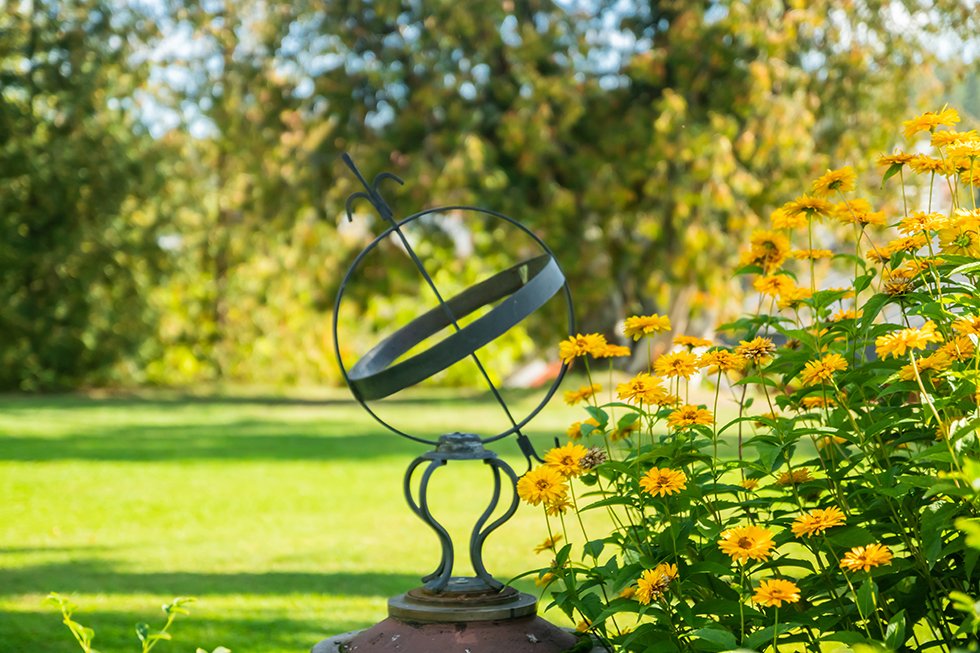
Each afternoon throughout the late winter, I inevitably pause on my travels back and forth between house and garage to gaze at the sundial in the upper garden. While the dial anchors this space year-round, now it takes on special meaning. There’s something deeply satisfying about watching the rimey dial patiently mark winter’s end across the cold, barren landscape. Though the light is weak and far from warm, as long as the sun shines even faintly, the shadow still traces the dial’s markings—as if to reassure me that all is well: the seasons turn, and spring will return.
Of course, the sundial didn’t begin as mere garden ornament. Dating back to ancient Egypt and Greece, sundials offered the only accurate timekeeping for millennia, their design a pinnacle of engineering and science. Large public dials often marked official business hours; one spectacular example was Emperor Augustus’s Horologium in Rome. For this giant—160 x 75 meters—he imported a 21-meter, 230-ton Egyptian obelisk as its pointer, its shadow sweeping across gilt numbers carved into marble paving. (Remarkably, while the dial’s delicate markings vanished long ago, the obelisk endured. Toppled and buried by the late 1700s, it was re-erected in the Piazza di Montecitorio, where it still stands on a recreated dial.)
Smaller dials became common in Roman homes, their need for clear sun relegating them to gardens. Cicero mentions wanting one for his Tuscan villa as early as 42 BC. Sundials persisted through the Middle Ages and Enlightenment, some gaining lunar or stellar features alongside solar timekeeping.
Surprisingly, sundials’ reign as primary timekeepers ended only recently. Until the mid-1800s, mechanical clocks were too inaccurate without sundial resets. Railroads changed everything: sundials track only local time, with noon shifting east to west. Slow travel tolerated this, but trains demanded synchronization. The 1884 conference divided the US into four 15-degree-longitude time zones, abruptly ending sundials’ 3,000-year dominance—usurped, improbably, by the train whistle.
This shift only boosted sundials’ garden appeal, freeing them for pure aesthetics. Their peak as ornaments came just before World War I, amid nostalgia for simpler times. Long-forgotten dials were revived, thousands newly made, and books devoted to their craft published.
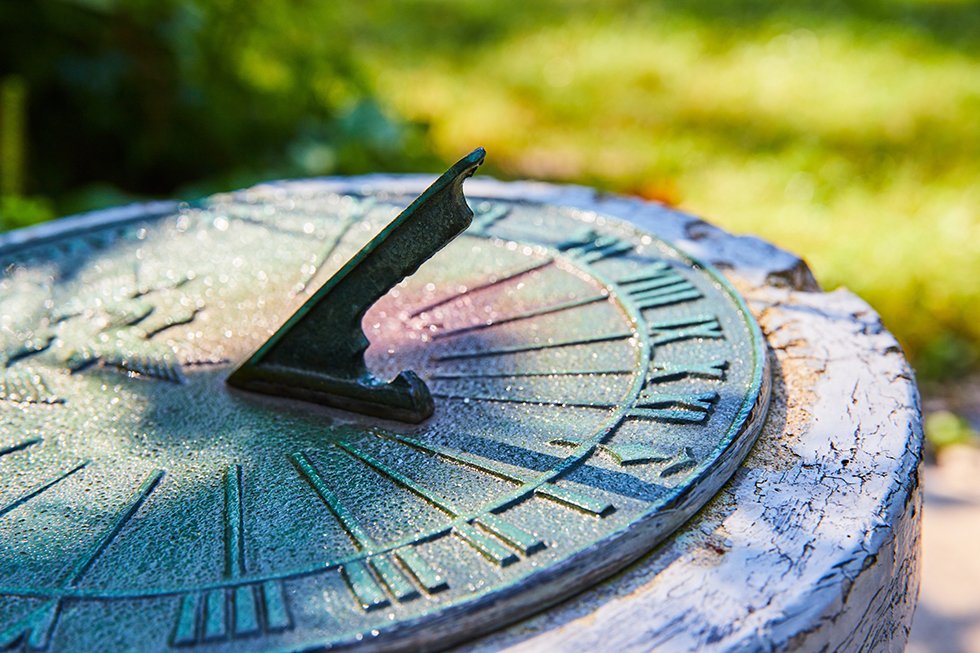
Today, sun time is a click away—sundials available in endless styles and budgets. For accuracy, though, precision matters: the gnomon must point true north (easy with a compass) and tilt parallel to Earth’s axis at your latitude. Custom dials match your spot perfectly; generics need slight adjustment. For specifics, consult a guidebook like Albert E. Waugh’s, Sundials: Their Theory and Construction. Of course, you can skip precision if timekeeping isn’t the point—but why miss this ancient ritual, steeped in such rich history?
Sundials shine as garden focal points, often inscribed with poignant mottoes on time’s passage. Latin dominates Western dials, though other languages appear too. Here are some favorites, all pre-1900 examples:
- Non numero nisi serenas (or aureas): Let others tell of storms and showers; I count only sunny hours
- Tempus fugit: Time flies
- BEHOLD AND BE GONE ABOUT YOUR BUSINESS
- Carpe diem: Seize the day
- Depressa resurgo: I set to rise
- Disce tuos numerare dies: Learn to number thy days
- Eheu fugaces labuntur anni: Alas, the fleeting years slip by
- Trifle not, your time is short
- L’heure passe, l’amitié reste: Time passes, friendship remains
- Festinat suprema: The last hour approaches
- Fumus et umbra sumus: We are naught but smoke and shadow
- Hoc tuum est: The present is all you may claim as yours
- Hodie mihi, cras tibi: Today is mine, tomorrow may be yours
-
The idle who would be counted wise,
Think all delight in pastime lies,
Nor heed they what the wise condemn:
As they pass time, time passes them - I note the time that you waste
- Now is yesterday’s tomorrow
- Mora trahit periculum: Delay is dangerous
- Mors omnia vincit: Death conquers all
- Nil dat quod non habet: Nothing comes of nothing
-
A clock the time may wrongly tell,
I never if the sun shines well - Neque lux sine umbra: There is no light without shade
- Nihil velocius annis: Nothing is swifter than time
- C’est l’heure de boire (or vivre): It’s time to drink (or live)
- With my shadow moves the world
- Sol splendit omnibus: The sun shines for all
-
Las klein stund fürüber ghan,
Du habst den etwas gut gethan:
Of the hours let there be none in which by you no good is done - We both hasten towards sunset
- Silens loquor: Though silent, I speak
- Lead kindly light