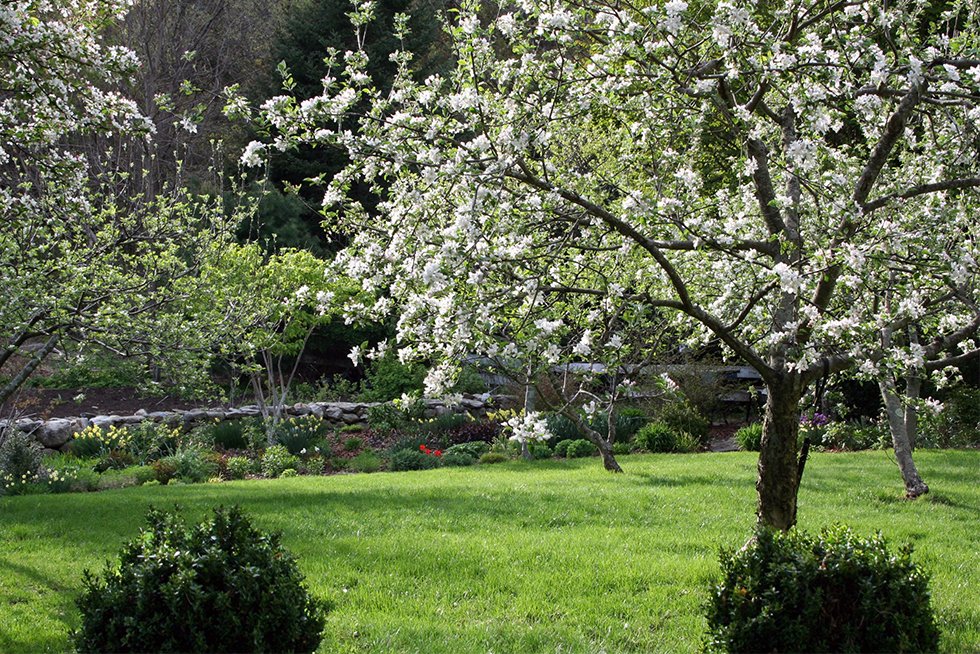
One of the very first things I did after I bought my home outside Boston was to plant an orchard of heirloom apple trees. Some people at the time thought that quite strange, especially since my 1852 house had neither working plumbing nor electrical systems, and the whole place, from rooftop to foundation, was under renovation. But I didn’t. While the workmen busily felled rain-soaked walls, ripped out damaged sills, and otherwise made a complete disaster of the interior, I—oblivious to all except a mounting unease about the costs—blithely prepared and cleared a piece of overgrown land and set out the trees I had purchased before I’d even closed on the property. Friends and neighbors would stop by and note the progress of the house renovation, then cast a bemused glance in my direction, wondering what in the world I was doing out there in the field.
But there was method to my madness. You see, the previous winter I had been bitten by the antique apple bug, seduced by catalogue descriptions of luscious, long-forgotten apples that were old when the Colonies were young. These were deliciously redolent apples not only for eating out of hand, but also for baking, cider, cooking, and general storage—fruit of sonorous name and historic association like Roxbury Russet, Tompkins County King, Cox’s Orange Pippin, and Duchess de Oldenburg. The books and catalogues promised culinary delights unknown to the modern purchaser of our hard, nearly flavor-free supermarket varieties, and I knew that if I wanted to sample these delights anytime soon, I needed to get started immediately.
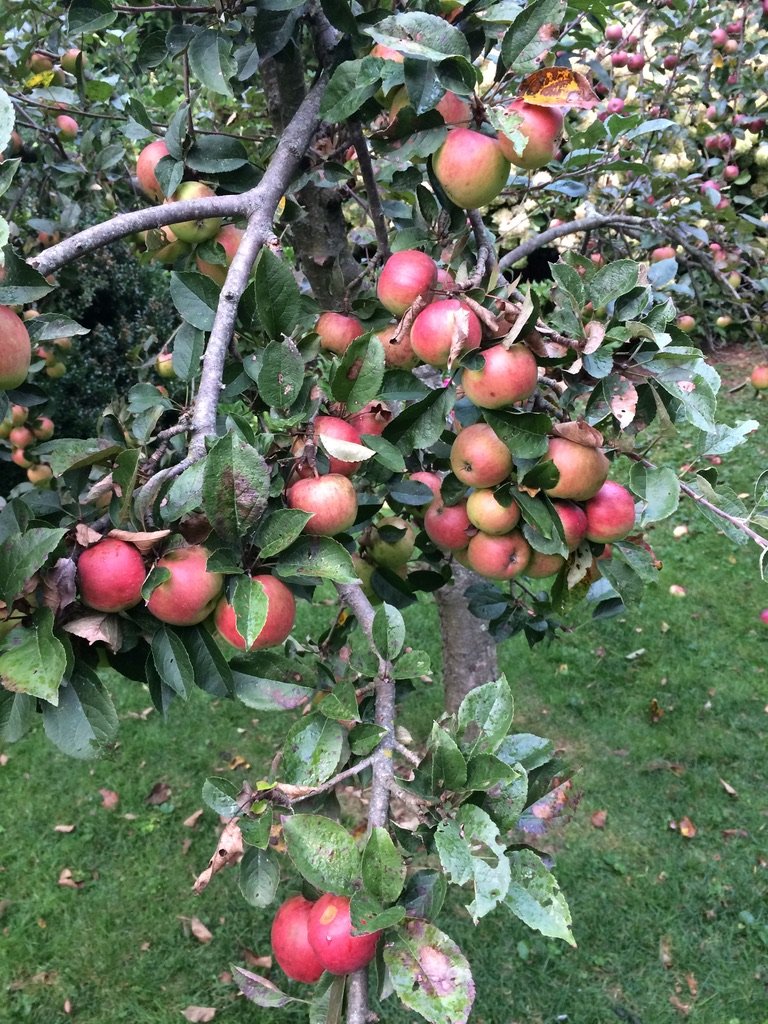
Now, almost fifteen years later, friends and neighbors wonder at my sanity no longer, as they are too busy marveling at the bushels of shining apples produced by these magnificent, long-lost varieties—and wondering why in the world they haven’t a tree or two in their own backyards. That’s a very good question, because as recently as fifty years ago, no homeowner worth his salt would have been without a small home orchard, with some selection of apples, cherries, peaches, and pears, depending on location. At the time, of course, this planting was a matter of culinary necessity. Fruit was often expensive and impossible to find out of season, and every industrious homemaker harvested and preserved her own if she wanted fruit in winter. These days, the appeal is not so much availability as quality. If you wish to experience fruit flavor, aroma, and texture unlike any store-bought apple (or peach, or plum), you must grow your own.
So, given all these obvious advantages, why aren’t there more home orchards in the American landscape? In part, it’s a question of perception: when I ask my clients if they’ve considered growing fruit trees on their property, their answer is almost invariably, “Well, we’ve thought about it, but they’re so much trouble and so messy that we never tried.” While it is true that apple trees require a bit of care, they really demand no more work than many common landscape plants—a once- or twice-a-year pruning, and, if you live east of the Mississippi where pests and disease are more prevalent, more than likely some sort of once-a-season spraying, which can be organic or inorganic according to your needs and preferences. As to the mess, once you taste some of these antique varieties, there will be few, if any, left on the ground to clutter the lawn, so that’s really not an issue either. (Horse, duck and chicken animal owners take note: windfalls make great feed.)
Getting started is easy. In fact, the hardest part of the entire process will be selecting which varieties to grow. Historically, apples were bred for specific uses—cooking, general eating, pressing for cider, winter storage ability, and the king of all uses, the dessert apple—meaning that there were, and still are, hundreds of varieties to choose from. Obviously, available space and planned use will force something of a triage, but that will still leave you in the happy position of selecting from dozens of different varieties. Fortunately, many historic museums and specialty orchards arrange tastings in the fall, and I highly suggest you attend and sample the delights before buying your trees. Apples have an amazingly varied range of flavors and textures, and I was surprised to discover, after attending just such a tasting at Old Sturbridge Village in Sturbridge, Massachusetts, last fall, that I had missed several truly spectacular apples in my initial selection a decade ago—ones I no longer have room to accommodate. The moral of the story: in the world of apples, as in all gardening, thorough research is everything.
Once you’ve done your homework and narrowed down your choices, it’s time to order plants, which will generally arrive through the mail in early spring as three-year-old “whips”—a single rooted shoot with a branch or two. Though tiny, given deep, cultivated soil, ample moisture, and sun, apples grow quite fast, and you can expect your first limited harvest in just a few years. Just be sure that when you choose your trees, you purchase dwarf (8–10 feet) or semi-dwarf (12–15 feet) species, even if you plan to devote considerable space to the enterprise. Each has its own set of advantages. Dwarf trees produce much more fruit per square foot than their full-size counterparts—and much sooner, too—so you can have many more varieties and harvest earlier than with standard-size trees. Personally, though, I prefer semi-dwarfs; they don’t need to be staked like dwarfs, and, to my eye, develop into a nicer-looking tree that remains compact enough to pick without too much trouble.
Ten heirloom apples for New England
- Roxbury Russet — One of the oldest American apples, excellent for eating, cider, and long storage. It is dependable and deeply flavored.
- Tompkins County King — A large, handsome apple with rich flavor, good for fresh eating and baking. It has a classic old-fashioned apple character.
- Cox’s Orange Pippin — Intensely aromatic and complex, with superb dessert quality. It is best where the growing season gives it enough warmth to ripen well.
- Duchess of Oldenburg — A tart, early apple that is especially useful for pies and sauce. It ripens relatively early and is very hardy.
- Northern Spy — A legendary New England apple, especially prized for pies, baking, and storage. It has a firm texture and a bright, balanced flavor.
- Ashmead’s Kernel — Small but exceptionally rich and spicy, with outstanding dessert quality. It stores well and develops even more character after picking.
- Esopus Spitzenburg — A bold, full-flavored heirloom often praised for its depth and balance. It can be challenging to grow, but the flavor rewards patience.
- Gravenstein — Juicy, fragrant, and excellent for sauce, pies, and fresh eating. It is beloved for its vivid flavor and early harvest.
- Ben Davis — A durable old American apple that stores well and was historically valued for cooking and keeping. It is not flashy, but it is reliable.
- Yellow Transparent — An early-season apple with a crisp, tart bite, especially good for sauce and baking. It is one of the first apples to ripen.