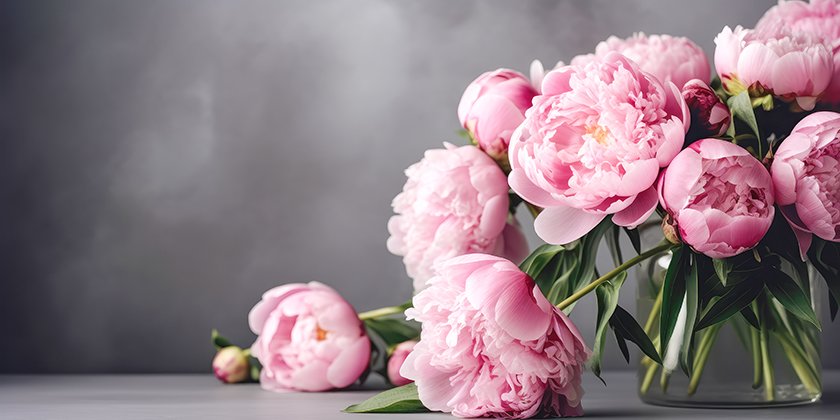
While many flowers vie for the title “Queen of the Garden,” for me at least, the peony wins the crown—its breathtaking blooms, fascinating pedigree, interesting foliage and habit, disease resistance, hardiness, and dependability all combine to make it one of the outstanding flowers of the garden and landscape.
Botanically, peonies are divided into two principal groups—herbaceous or “garden” peonies (sometimes confusingly called Japanese or Chinese peonies) and tree peonies. The former type is the one most people think of when they visualize peonies. It owes its existence to crosses made primarily from P. lactiflora, which is native to regions of Siberia and Manchuria, and P. officinalis, which originated in southern Europe. (Officinalis, which you see tacked onto the species name of many plants, is Latin for “of the apothecary” and indicates a long history of medicinal use.) According to legend, the flower was named for Paeon, a famous physician who used its miraculous powers to cure the wounds of the gods Pluto and Mars. The great encyclopaedist Pliny the Elder, in his monumental work Natural History (70 AD), lists over 20 illnesses that peonies cured, with special emphasis on their use as a treatment for epilepsy. The medicinal use of peonies continued throughout the Middle Ages, and no good physic garden was considered complete without them. Peonies arrived in this country with the first settlers and were popular throughout the Colonies—Thomas Jefferson, for example, listed them in his garden.
Herbaceous varieties are described by the number of petals per flower. They are, in ascending order of fullness: single, Japanese (a fuller type of single), semi-double, double, anemone (a double type with a full center surrounded by a ring of single petals), and bomb (extremely double, almost triple). Peonies, with their heavy scent and huge blooms, make excellent cut flowers. In fact, stems of the garden peony may be cut just before the flower bud is ready to open and stored for use months later in fragrant summer bouquets (see the sidebar for details).
Tree (or Moutan) peonies are shrubby or woody plants, from 3–10 feet high, that originally came from China and Tibet, and in many ways are quite different from their European cousins. Prized by the Chinese and Japanese for centuries, and often appearing in their art, the flowers of the tree peony are more open, with large yellow anthers in the center and an almost crepe-like texture to their petals, which adds a ruffled delicacy to the plant not found in Western peonies. Nor do tree peonies die down to the ground like the garden variety; their woody stems, some rising to six feet, remain upright throughout the winter, though they do lose their leaves. Both types are very cold hardy; the garden type doesn’t care much for climates warmer than Zone 8, where the winters are not cold enough to cause dormancy. (Tree peonies, contrary to the advice often seen in books, seem to do just fine in areas as far south as Atlanta.) While garden peonies prefer full sun, the tree varieties actually prefer dappled shade and make terrific understory plantings. Tree peonies are also quite slow-growing, often taking several years to come into bloom; this slow rate of growth makes them considerably more expensive than the more rapidly maturing herbaceous peonies, but their ease of culture and spectacular blooms more than make up for the delay.
Peonies, both regular and tree types, are remarkably tough and easy to grow, as long as a few specific requirements are met. While potted specimens of both can be planted at any time during the gardening year, bare-root herbaceous peonies—the kind shipped by most mail-order suppliers—are planted exclusively in the fall. Peonies do not like to be moved, often growing happily in the same location for 50 years or more, so ample preparation of the soil should be undertaken before planting. Find a well-drained location that meets the light requirements of the variety you have chosen, and begin to prepare the soil, digging a hole at least a foot deep, removing all rocks and stones, and amending the soil heavily with compost or rotted manure. Then in the center of the hole, make a mound that comes within three or four inches of the top. Take the bare root, with the eyes (those small reddish shoots) facing up and the large, tuberlike clipped roots pointing downward, and place the plant so that the eyes will be about two inches below the surface of the soil. Though it may seem too close to the surface for comfort, planting any deeper will result in lots of leaves and no flowers. Too much mulch accumulating over the years can have the same effect, so be sure not to let the crowns become buried.
Peonies are generally untroubled by insects, though many people have remarked over the years on the presence of ants on the large swollen peony blossoms just before they open. Some gardeners worry that the ants will somehow damage the blooms and go to great lengths to remove them. In fact, some guides, published as little as twenty years ago, recommended a pesticide application to get rid of the ants. Further research has shown that this is one of the many occasions when the gardener should just relax and let nature take its course. The ants are actually present to harvest the crop of sweet, sticky nectar that the peonies produce on their flower buds. Though it has never been proven, biologists have theorized that the peonies deliberately secrete the nectar to attract the ants. Their presence, which is completely benign, may serve to keep other, more harmful insects away at a time when the half-open buds are especially susceptible to potential damage.
Heirloom Peonies
For those interested in heirloom flowers, quite a number of antique varieties can still be commonly found on the market.
- Duchess de Nemours (1856): White with yellow center
- Baroness Schroeder (1889): White with yellow center
- Edulis Superba (1824): Old rose pink
- Humei (1810): Cherry pink
- Festiva Maxima (1851): White
- Felix Crousse (1881): Red
- Monsieur Jules Elie (1888): Medium pink with creamy center
- Sarah Bernhardt (1906): Apple-blossom pink
Modern Peony Varieties
Here’s a list of ten recommended modern herbaceous peony varieties, prized for their vibrant colors, strong stems, and reliable blooming. These post-1950 cultivars complement the heirlooms with bolder hues and hybrid vigor.
- Coral Charm (1974): Semidouble coral fading to peach
- Red Charm (1944, modern classic): Bomb deep crimson red
- Lois’ Choice: Double soft pink-apricot to yellow-pink
- Sonoma YeDo: Fully double clear yellow
- Etched Salmon: Double bowl-shaped salmon pink
- Lorelei (1985): Double orange-pink fading to peach
- Raspberry Sundae (1989): Bomb pink with creamy white petaloids
- Morning Lilac: Semidouble rich purple-pink
- Orange Victory: Semidouble peachy orange with red center