“That headlong ivy! Not a leaf will grow
But thinking of a wreath…”
— Elizabeth Barrett Browning, Aurora Leigh (1856)
Looking for a task that was not too trying in yesterday’s 90° heat, I decided to trim the ivy that had started to completely cover the path from the back arbor. Historically this was something of a sweaty pain—one that required a good half hour or so on bended knee with clippers in hand—at least until I discovered one of the handiest tools in my garden: the little cordless hedge trimmer, which neatly edges the entire 50-foot length in about one minute. A quick rake, and I’m done. The only real problem I have now is throwing away the clippings, because with each sprig, I’m tossing away a bit of history.
You see, my ivy isn’t just any ivy; it has a very impressive pedigree. Many years ago, when I was researching my first book, The New Traditional Garden, I was given a guided tour of Sunnyside, the home of Washington Irving on the Hudson. Everywhere in his garden were luxuriant beds of ivy, which immediately caught my attention, having grown up in Wisconsin, where ivy isn’t hardy. I remember remarking to one of the curators how pretty I thought the neatly trimmed beds were. “Oh,” she said, “it’s a bit of a chore keeping them in check, but they do look nice when they’re done. Speaking of which, would you like a few cuttings for your own house? I think Washington Irving would approve; he himself received the original sprigs from Sir Walter Scott.” And so my visit ended with three pieces of ivy carefully wrapped in wet paper towel. It was a near thing getting the ivy home, as this was at the start of a three-week-long trip, and several times the ivy was almost crushed, lost, or tossed. But eventually, the slightly battered sprigs made it back to my garden, where one rooted—the single progenitor of what is now a huge bed.
But this literary association isn’t my only fascination with ivy; I continue to be bowled over by the incredible amount of lore associated with the plant. Ivy was, for instance, historically associated with, of all things, wine. It was ivy that the wine-soaked followers of the Roman god Bacchus wore during their winter rites, decking themselves and the god with ivy garlands. (Summer garb, appropriately enough, was decorated with grape leaves.) In fact, so familiar and long-running was this relationship between ivy and wine that until the 1700s many British pubs were distinguished only by a bush of ivy to advertise their presence. A cup made of ivy wood was said to be able to detect adulterated wine (more on this strange phenomenon of “ivy wood” shortly). Drinking from these ivy cups was also said to cure a number of illnesses, especially whooping cough. (All that wine may have also played no small role in these supposed “cures.”) Eating the plant directly—today known to be dangerous—was formerly believed to be beneficial for numerous ailments. In fact, so various were the prescribed medical uses for the plant that, as the garden historian Alice Coats wryly notes, the number of potential cures suggested “experiment rather than experience… one cannot avoid the suspicion that ivy was so much used simply because it was always in hand.” Conversely, in the nineteenth century ivy became associated with death and decay, probably because of its uncanny ability to climb over and instantly age any kind of ruin. As Dickens notes in The Pickwick Papers, “For the stateliest building a man can raise is the ivy’s food at last.”
The myths of ivy extend even to its origins, both etymological and botanical. Supposedly, the word ivy may derive from the Old English ifig, itself a corruption of the Old English iw, meaning green—a base which also gives us the word yew. But this etymology is rather shaky. The Latin name hedera may derive from the Celtic haedra, meaning cord. This makes some sense at least, given the Celtic Druids’ reverence for the plant and its inclusion in their religious rites. (Remember that carol “The Holly and the Ivy”? It’s one of the most ancient on record and full of thinly Christianized Druidic imagery.) Botanically, while it’s obvious that many of the hundreds of ivies found in cultivation today are descended in one way or another from H. helix, the English ivy, others are the products of numerous crosses—both deliberate and accidental—between other species such as H. chrysocarpa (Italian ivy), H. colchica (Caucasian ivy), and H. hibernica (Irish ivy).
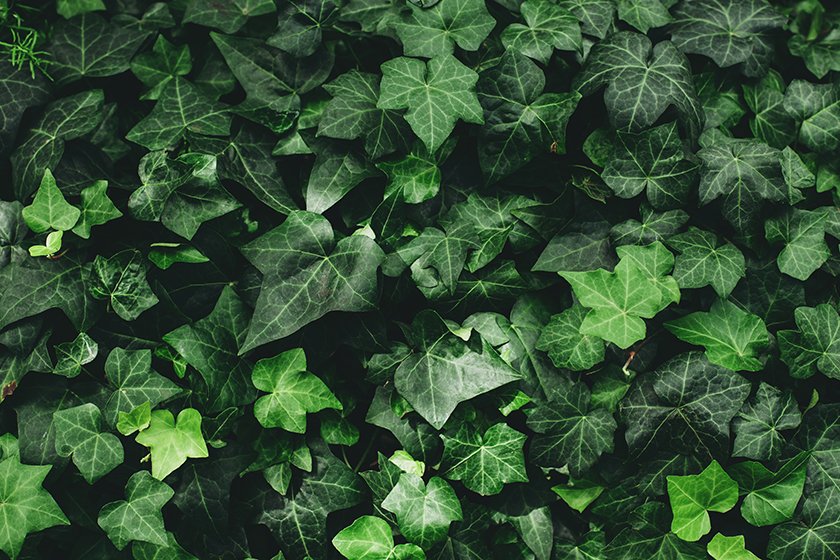
Part of the ancients’ reverence for ivy may have to do with its bizarre habit—one that, to my knowledge, is unique in the plant kingdom—of undergoing a fascinating biological change, hence my previous allusion to “ivy wood.” Those of you familiar with ivy from more northerly climes may wonder how those tiny thin vines could ever be called wood, never having seen a fully grown ivy plant; the winters there are simply too severe to allow the ivy to fully mature. Gardeners in milder climes, however, are well acquainted with the ivy’s habit (some might be tempted to call it “pernicious”) of ascending twenty, thirty, often forty feet into the tops of trees by means of little hairy rootlets that attach to anything rough. As the ivy reaches the crown, a strange thing happens—the vines undergo a change, becoming a quasi-tree. In this arborescent form, the leaves, which previously were triangular and pointed, become rounded; the vines thicken massively into trunks; the plant flowers (with greenish-yellow blooms) and produces berries which are the delight of birds—and, of course, help spread new little ivy plants everywhere. Interestingly, when cuttings are taken from these metamorphosed versions, they don’t revert to vines; instead, the cuttings will form bushes or small trees—whence comes “ivy wood.”
Ivy’s habit of climbing trees has caused a great storm of debate amongst gardeners for centuries, which continues to rage on and off to the present day: Is, or is not, ivy harmful to the things it climbs upon? The best answer (as is often the case in gardening) is: “It depends.” Ivy is categorically not a parasite and does not receive nourishment from the plants it climbs upon. You can prove this to yourself by severing the end of any vine—the leaves will immediately begin to wither and die, as the tip can no longer draw sustenance from the main stem. However, in climates where ivy can fully mature, the massive weight of the thickened vines—especially in older or diseased trees—plus the tendency of such dense evergreen foliage to act as a giant sail, may be enough to cause the whole mass—tree and ivy both—to come crashing to the ground in high winds. Likewise, opinions are divided on ivy’s role in causing decay when climbing on masonry. Some masons I know insist that the small rootlets work their way into the mortar and cause the pointing to crumble. Others argue that the roots only adhere to the very top surfaces, and far from causing the mortar to decay, the shade from rain and sun provided by the leaves actually helps preserve the bricks and mortar from natural decay; it’s the process of periodically ripping down and removing ivy from where it is not wanted that serves to loosen the pointing. You’ll have to decide. Personally, having been ivy-starved in my youth, I am happy wherever it grows in my garden—its cheerful green leaves a pleasant reminder of a long and storied past