Creating the perfect lawn is far harder than most people think. As a landscape designer, I can assure you that there is nothing more attractive in the garden than a well-tended, well-proportioned lawn. No other feature of the landscape is as effective at linking together disparate elements of the yard as a flourishing piece of greensward. The problem lies in the “well-tended” and “well-proportioned” part—i.e. the factors that make a lawn “perfect”. In terms of maintenance, despite the fact that we Americans spend billions of hours and dollars each year on lawn care, much of our effort is wasted. Many, and in some areas most, of the lawns you see are brown, patchy, bumpy stretches of weeds, especially after the searing heat and extended drought of the last few years. As for proportion and scale, it’s a common sight all over America to see the lawn dominating the landscape, instead of complementing it. A landscape that is all grass (especially bad grass), and very little else, is not really landscape at all, merely a bad lawn. How did we get into this fix, anyway?
The history of the American lawn’s rise to preeminence in our landscapes is a fascinating one, especially considering the fact that two hundred years ago, there were almost no lawns in American gardens. While our forebears did enjoy extremely ornate and elaborate landscapes, they were almost entirely without what we would nowadays call a lawn. Why? Because mown grass was expensive and difficult to maintain. To get the flat, green look we so prize today, two centuries ago you either needed a small flock of sheep and someone to tend them and to manage their compost contributions to the lawn surface, or a full-time gardener with a scythe. Closely scything a lawn, I can assure you from personal experience (having foolishly attempted it once, almost cutting off my leg in the process), is an extremely difficult and time-consuming affair. Thus, only the richest of the rich had lawns, and then only tiny areas of close-cropped grass suitable for outdoor games like boules — a form of bowling — which were then all the rage.
This grass-less landscape changed forever in 1830, when two enterprising (or fiendish, depending on your opinion of mowing grass) British gentlemen by the names of Edwin Budding and James Ferrabee came into the picture. Having seen the large-bladed machines used in mills to remove excess nap from woolen cloth, they decided that the same process could be adapted for cutting grass. Their invention instantly removed the main impediment to having a lawn — the lack of an easy, cost-efficient means of mowing it. Suddenly, everyone from maid to minister could have their own perfect, green carpet with minimal labor, and lawns sprang up everywhere as the ultimate status symbol in the Victorian garden. Strangely enough, this sine qua non has remained the case ever since, despite the fact that any status associated with having a large lawn has long since disappeared. For better or for worse, the modern lawn has become an integral part of the American landscape, and I doubt that anything short of a second American revolution would remove “a good lawn” from the wish list of most gardeners.
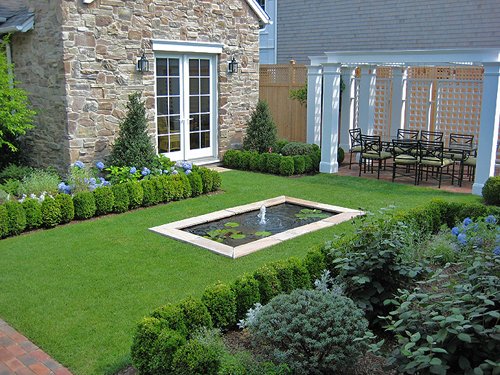
Since lawns do indeed seem to have become a permanent feature in our gardens, at least we should do what we can to enhance them, especially when there are a number of ways we can make considerable improvements to our grass, without making a commensurate dent to our pocketbooks.
1) Assess the Amount of Lawn You Now Have, versus How Much You really Need. Take a look around your property. Unless you are hosting team soccer games or otherwise need extremely large play areas, if any one section of your yard (such as front, back or side) consists of 60% or more grass, consider re-landscaping to convert the lawn areas to other types of plantings. Let’s face it — lawns, especially good ones, require a lot of work, and today’s busy gardener needs to make every moment count; huge expanses of grass are not only dull, but also time-consuming to maintain, and in many hot, dry areas of the country where water is an issue, environmentally unsound. Why not convert some of these areas to alternative groundcovers, shelter plantings or ornamental landscaping? In very large yards (of several acres or more) letting the grass revert to natural or woodland areas may be the way to go. Here in my garden over the last few years we have eliminated almost 2 acres of lawn along the property borders, allowing meadow to grow up in its place, which only has to be mown once a year. Not only are these naturalized areas far less work to maintain, but the return of numerous native species of birds, animals and butterflies has been a tremendous side-benefit. Plus, not having to tend these marginal sections has allowed me to concentrate my time and resources on the remaining lawn, with the result that I now have far better grass in the areas where it counts most.
2) Sharpen Your Mower Blades. Sounds simple enough, but when was the last time you actually sharpened those blades? A survey by the International Turf Producers Foundation shows that only 38% of gardeners do so. Dull blades not only consume much more energy than sharp ones to cut the same grass, but the dullness also causes ragged cuts and gashes to the grass stems, which can lead to disease and stress. Turf professionals recommend sharpening the blades several times during the season. Simply take the mower to your local dealer or repair shop. (If you are mechanically handy, and know what you are doing, you can also sharpen them yourself.) The process takes minutes and costs only a few dollars, and will lead to a far healthier, better-looking lawn.
3) Raise the Cutting Height of Your Mower as Summer Heat Increases. As the summer heat wears on, move up the cutting height on your lawn mower by several notches. By increasing the height, you increase the length of the grass blades. The more blade surface the grass has, the better it can produce its own energy from the sun, with less need for supplemental feeding.
4) Don’t Fertilize or Use Pesticides During a Drought. Again, according to the International Turf Producers Foundation, many people try to fertilize their way out of brown summer lawns. During a drought, your grass is not growing vigorously, and will not absorb fertilizers. Pesticides can actually place stress on already weakened grass. Wait until normal rainfall and cooler weather returns to make any lawn treatments truly effective, both in terms of cost and benefit.
5) Check Your Lawn for Thatch. Thatch is a deposit of dead grass that over time can accumulate on lawns. Not only is it unsightly, but a layer of thatch more than 1/2 inch thick effectively acts as a barrier to the soil, preventing the absorption of much-needed nutrients and water. Contrary to popular belief, excessive thatch is not caused by leaving normal amounts of clippings on lawns from mulching mowers and the like. Instead, thatch is primarily composed of the tougher parts of the grass — stems, stolons and roots — that have failed to decompose properly. Excessive thatch is a sign that something is wrong with your lawn care: excessive chemical treatments, cutting the grass too short, or over-watering are all potential causes. Remove excess thatch with a rake or a de-thatching tool, and amend your lawn care practices to prevent its return.