Let’s face it: we Americans are prejudiced, at least when it comes to fall gardening. By and large, we plan and plant our gardens almost exclusively for the spring and summer, and relegate any consideration of autumn—if that season even enters our consciousness—to worries about collecting leaves and putting away tools. This is really a shame, because given the autumn weather over most of the country, fall is probably the best time of all to be out in the garden—sunny, cool, and dry, with lingering golden days completely unlike our generally wet, dreary springs and our completely torrid summers. So why don’t we plan our gardens more with fall in mind? There are, after all, a whole host of wonderful plants that will extend the summer bloom right up to frost.
According to Allen Lacy, who first brought this bizarre bias to light in his marvelously lyrical 1990 book The Garden in Autumn, the reasons we favor spring and summer gardening over that of fall are threefold:
- Our native forests and woodlands, renowned worldwide for their unique autumnal display, are so spectacular that we relegate our gardens to second place. (That sounds reasonable.)
- By societal metaphor, we consider fall a time of closure and decay; if spring is youth and summer maturity, then fall must be a time of somber senescence. (Hmmm… not quite so sure about that one.)
- Even after 200-odd years of self-rule, we are still influenced by British gardening practices and advice. (This is absolutely true.) In Britain, where thanks to the Gulf Stream winters are mild, springs come early, and summers are cool, fall, in stark contrast, is generally dank, damp, and drizzly. Thus, British gardens have always stressed—and continue to stress—the spring and summer as the prime periods for enjoying the garden.
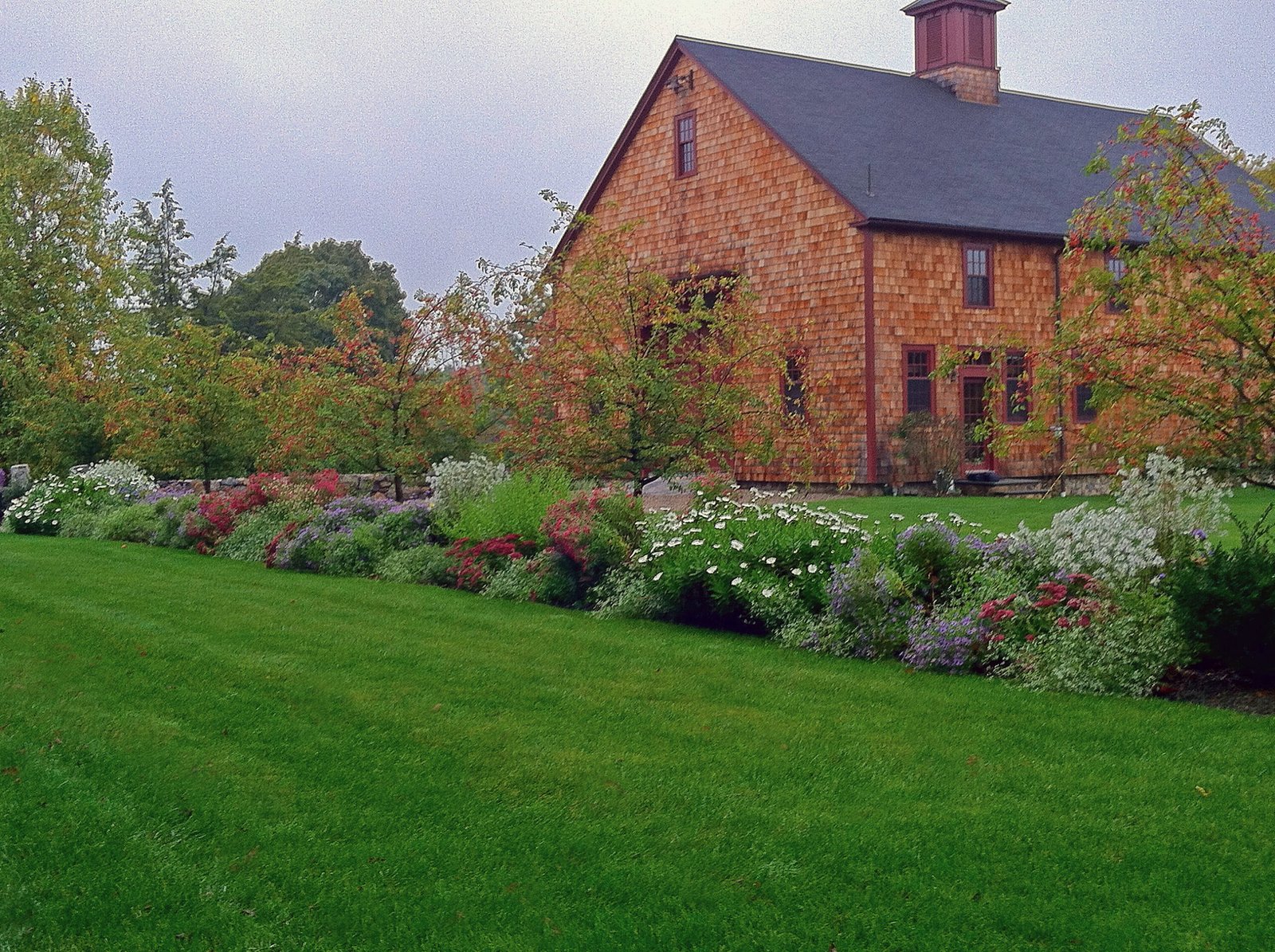
However, in most of America, the exact opposite is true—fall is the best of our horticultural seasons. Not only is the weather perfect for a variety of horticultural tasks, including dividing, transplanting, and establishing new beds, but we are blessed with a whole host of fall perennials—many of them derived from American natives—that are the envy of British gardeners (or would be, if they could grow them successfully). So here’s my vote: after three centuries of looking long and longingly toward English gardens as a model, perhaps it’s high time to give up mooning over things we can’t have and start appreciating some of the underrated wonders we possess right here at home—namely, an abundance of beneficent autumn weather and a cornucopia of fantastic plants for fall bloom. To get started, here are five must-have perennials for your garden.
Boltonia asteroides ‘Snowbank’
If I were forced to choose only one plant for the fall border, this might be it. Appropriately named, this American native—pretty much neglected until fairly recently—covers itself in a mass of snow-white, daisy-like flowers for almost a month in September. Extremely easy to grow, Boltonias hold true to their wild roots: they are reasonably indifferent to soil quality and will tolerate fairly dry conditions. They do, however, require full sun and several years to reach their final height of four feet. Boltonias are perfect for massing at the back of the border, especially when paired with asters and chrysanthemums. The variety ‘Pink Beauty’ is another of my favorites and makes a particularly lovely companion to ‘Snowbank.’ (Z 3/4)
Anemone × hybrida ‘Honorine Jobert’
Despite its almost unpronounceably long French name—and not to mention the fact that, contrary to nomenclature, this so-called “Japanese” anemone hybrid was accidentally discovered in Verdun, France, in 1858—‘Honorine Jobert’ is a star of the fall garden and another of my favorite autumn plants. Fairly easy to grow, ‘Honorine Jobert’ thrives in consistently moist, semi-shady spots. (In another apparent contradiction, this anemone requires consistent moisture plus a well-drained soil—standing water will cause it to rot.) Although often painfully slow to establish, ‘Honorine Jobert’ will reward your patience by eventually growing 3–4 feet tall and covering itself with attractive dark green leaves and white single flowers that are excellent for cutting. (Z 4)
Aster novae-angliae ‘Alma Potschke’
Here’s an instructive lesson for American gardeners: for us, it seems that a plant is rarely a prophet (or of profit) in its own country until it gets gentrified by a trip abroad. Our native New England asters, also called Michaelmas daisies, were considered nothing but roadside weeds until they attracted the attention of European breeders. After being sent across the pond and tinkered with a bit, they came back to us in a variety of new, improved forms. Among them was a true winner, ‘Alma Potschke.’ Growing 4–6 feet tall and about 3 feet wide, this plant is excellent for the rear of the border and covers itself in 2-inch-wide, daisy-like flowers well into October. One of the few late-season plants for bees and butterflies, ‘Alma’ requires full sun and a well-drained soil. (Z 3)
Chrysanthemum ‘Sheffield Pink’
If you’ve been following the nomenclature battles over the constantly changing names of the chrysanthemum family, you’ll be relieved to know that this old cultivar has been returned once again—at least for the moment—to the chrysanthemum clan, a moniker far preferable to the absolutely forgettable Dendranthema. By any name, ‘Sheffield Pink’ is a winner. Growing to about three feet tall, it covers itself in salmon-pink blossoms for an entire month in October and also makes an excellent cut flower. Perhaps its only drawback is that ‘Sheffield’ can be a bit floppy and requires staking or, better yet, the presence of another tall, sturdy neighbor—but when you’re this charming, what are a few weak knees among friends? (Z 5)
Aster frikartii ‘Wonder of Staffa’
Beginning in July and lasting well into October, the yellow-centered purple flowers of ‘Wonder of Staffa’ are truly a delight. Growing 2–3 feet tall and about as wide, this plant is fairly indifferent to soil and prefers full sun. A good candidate for drier sites, this German introduction is beloved by bees and butterflies and makes an excellent cut flower. (Z 5)
So, this year, if you’re tired of our British friends always winning the gardening wars, start thinking fall, start thinking fall planting, and start thinking fall perennials. Who knows—you may start a whole new American revolution right in the middle of your garden.