I live not terribly far from a kind but occasionally rather patronizing older lady who fancies herself quite an expert gardener, especially when any kind of public podium is provided. Over the years we’ve become friends, and she’ll often stop by to see what new things are occurring in the garden. The other day she arrived while I was out planting in the shade border and inquired what I was up to. “Just doing some research for my next column about shade-loving groundcovers,” I replied. “Pleeeaase,” she said with a note of utter boredom, “not more about that dull subject of pachysandra and ivy. What new could you possibly find to tell us there?” “Well,” I replied somewhat icily, “while I do share your aversion to pachysandra, there’s actually quite a lot of interesting culture and lore not generally known about ivy… But that subject I’ve already covered”—adding the last bit with just enough of a pregnant tone to suggest that next time the old dear felt the need to comment on my themes, she might first do me the courtesy of actually reading my pieces—“this month, however, I’m going to discuss underused groundcovers for shady sites.” “Oh,” she said, “that sounds quite useful.” I hope you’ll think so too, because one of the hardest challenges the gardener can face is how to cover the ground in those shady spaces where very little seems to want to grow.
First, though, it’s important to talk a bit about what constitutes a groundcover, because the term can be somewhat misleading. Many gardeners suppose that a “groundcover” is by definition some low, creeping plant that quickly expands by root or tendril to completely fill the space allowed. While many traditional “spreading” plants fit this bill, such as the dreadfully overplanted, plastic-looking pachysandra, there are many other “clumping” plants that can be used to “cover the ground” simply by massing them closely together. Although this is a simple distinction, it’s a crucial one, because it suddenly opens up a whole new realm of plant possibilities for shady spaces. Nor do “groundcovers” have to be low—depending on your site requirements, plants from a few inches to a few feet tall, sufficiently massed together, will completely cover the earth and prevent weeds from arising—which is how I define a groundcover plant. Given this expanded definition, here are suggestions for shade-loving groundcovers (USDA Zone 6 hardy).
-
Epimedium × versicolor ‘Sulphureum’ (Barrenwort)
This Eurasian native normally appears in our gardens as an individual specimen in the perennial border, but in its natural forest habitat it forms large masses on the forest floor. ‘Sulphureum’ is an improved yellow-flowering cultivar whose blossoms appear in mid-spring. The bronze/green deciduous foliage grows to about 12 inches. This clumping plant spreads very slowly, so plant closely together if you wish quick results. Incidentally, while Epimediums prefer average soil with decent moisture, they are one of the plants that will tolerate dry shade, such as that found under large trees, as long as you water frequently until they become established. Zones 5-9. -
Waldsteinia ternata (Barren Strawberry)
The common name of this plant is well deserved: its leaves resemble the common strawberry, the creeping and rooting stems spread the plant in the same way, and in fact, Waldsteinia is a close relative of its culinary cousin. Waldsteinia’s attractive yellow flowers appear above the 4-inch-high foliage in mid-spring and remain semi-evergreen in warmer climates. Waldsteinia prefers heavy shade and rich, moist soil. Zones 5-8. -
Convallaria majalis (Lily-of-the-Valley)
Unless you’ve had the pleasure, as I did as a child, of walking through woods carpeted with lily-of-the-valley, you might not consider this highly fragrant flowering plant a groundcover. But given time, and the woodland conditions it adores, it will soon spread—perhaps even a little too well. This is one of the few groundcovers I know that will tolerate the unbroken shade commonly found on the north side of a house: at my sister’s home in Milwaukee, thousands of descendants of the dozen plants my mother and I collected in the woods over 25 years ago still cover ground where nothing else will grow. If you can, try to track down some of the newer, interesting cultivars in addition to the species, such as ‘Albostriata’ with striped leaves, ‘Flore Pleno’ with double white flowers, or ‘Rosea Plena’ with double pink. Zones 2-7. -
Carex morrowii ‘Ice Dance’ (Ice Dance Sedge)
This is rapidly becoming one of my favorite plants for the shade garden. Introduced in 1996, ‘Ice Dance’ has thick, fleshy leaves with green-and-white stripes that are a distinct improvement over the far less substantial grass-like foliage many others of this clan possess. Although like most sedges, ‘Ice Dance’ prefers damp, shady sites, mine grows quite contentedly in normal garden soil. Spreading slowly by rhizomes, ‘Ice Dance’ is a perfect candidate for massing. Zones 4-9. -
Asarum canadense (Canadian Wild Ginger)
A superb native for deep, dry shade under trees, this forms glossy, heart-shaped leaves to 6 inches high. Semi-evergreen and deer-resistant, it features subtle maroon bell flowers hidden at soil level in spring. Excellent for massing in woodland gardens. Zones 4-7 -
Tiarella cordifolia (Foamflower)
This native charmer produces foamy white racemes in spring above maple-like leaves that often bronze in fall. Ideal for moist, dappled shade; clumps slowly but masses beautifully to suppress weeds. Zones 4-9. -
Phlox stolonifera (Creeping Phlox)
A non-invasive woodland native with lavender-blue spring flowers over 6- to 12-inch foliage. Spreads gently in part shade; cultivars like ‘Bruce’s White’ add variety. Excellent for erosion control on slopes. Zones 5-9. -
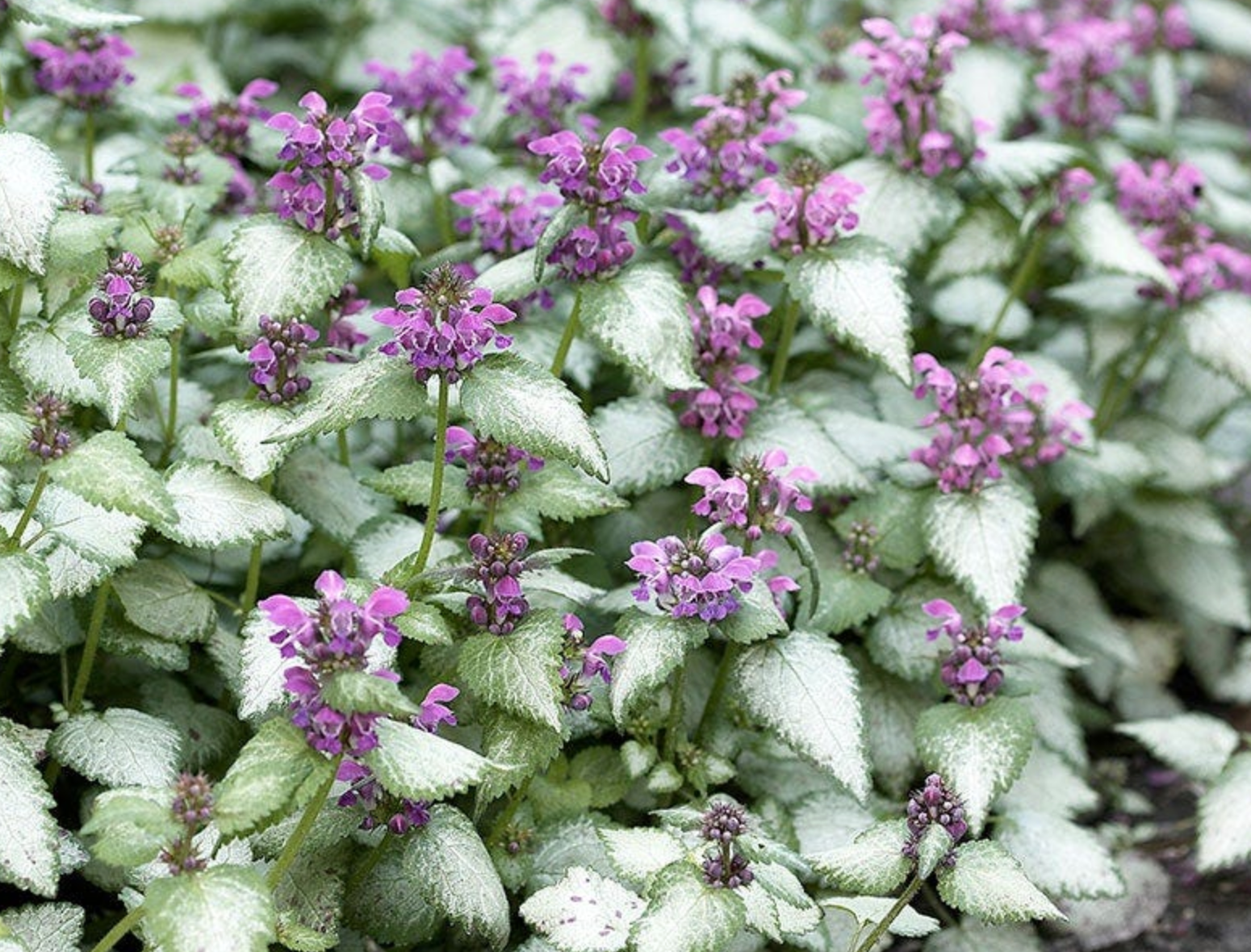
Lamium maculatum ‘Orchid Frost’ (Orchid Frost Dead Nettle)
This dazzling shade lover forms silvery leaves with green edges and masses of orchid-pink flowers in spring. Grows 6-8 inches tall, spreading moderately by creeping stems in part to full shade. Tolerates average soil; cut back after bloom for fresh foliage. Zones 4-8. -
Ajuga reptans (Bugleweed)
Forms dense mats with colorful foliage (often bronze or variegated) and spikes of blue flowers in spring. Ideal for moist shade; grows 4-6 inches tall and spreads reliably without being overly aggressive. Zones 4-9. -
Brunnera macrophylla (Siberian Bugloss)
Large heart-shaped leaves with sprays of blue forget-me-not-like flowers in spring. Excels in rich, moist shade to 18 inches; ‘Jack Frost’ cultivar adds silver variegation. Zones 3-7. -
Carex pensylvanica (Pennsylvania Sedge)
Native grass-like sedge with fine green texture to 6-12 inches; perfect for dry to moist shade. Forms loose colonies naturally; low-maintenance and deer-resistant. Zones 3-8. -
Epimedium species (Barrenwort)
Delicate, dangling flowers in spring over heart-shaped leaves that often color up in fall. Highly drought-tolerant once established in dry shade; species like E. rubrum add red tones. Zones 5-9. -
Vinca minor (Periwinkle)
Tough evergreen with small glossy leaves and blue-violet spring flowers. Excellent in heavy shade to 6 inches; spreads vigorously (monitor for invasiveness). Zones 4-9.
So, can you guess what happened next? Having listened to my explanation (as well as discreetly noting down my selections when she thought I wasn’t looking), my gardening friend soon departed, and I could almost hear the distant cha-ching of the cash register at the local nursery tallying up a list of plants that I was certain would bear a strange resemblance to the one above. And sure enough, several weeks later at a garden function, I overheard my friend telling one of her club acquaintances, “You must, my dear, be sure to find some of that wonderful Epimedium ‘Sulphureum’—I find it a supeeeeeeeerlative shade groundcover…” a bit of advice I hope you’ll find equally useful in your garden.